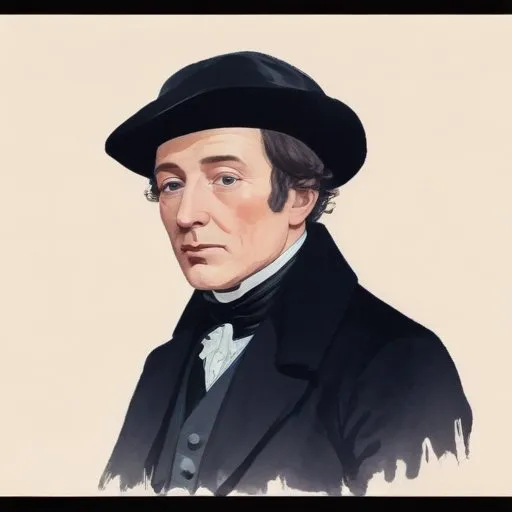
Edward FitzGerald: The Poetic Translator of the East
A Life of Luxury and Literary Pursuits
Edward FitzGerald, renowned for his majestic translation of
The Rubaiyat of Omar Khayyam, is one of the most celebrated poets and writers of the 19th century. His work has captivated readers for generations, bringing the mystical and philosophical essence of the East to the Western world.
Early Life and Family Legacy
Born Edward Purcell in 1809, at Bredfield House in Suffolk, England, FitzGerald was part of the esteemed FitzGerald family, known for their immense wealth and influence. His father, John Purcell, assumed the FitzGerald surname and arms in 1818, after his wife inherited a substantial fortune. This change in family name marked the beginning of a life of luxury and privilege for the young FitzGerald.
Cultural Influences and Education
FitzGerald's family moved to France in 1816, where he was exposed to the rich cultural heritage of Europe. He spent time in St. Germain and Paris, developing a deep appreciation for art, literature, and philosophy. In 1821, he attended King
Edward VI School in Bury St. Edmunds, and later, Trinity College, Cambridge, where he befriended notable writers and intellectuals, including
William Makepeace Thackeray and Alfred Tennyson.
A Life of Quiet Contemplation
After leaving Cambridge, FitzGerald lived a life of quiet contemplation, surrounded by nature and literature. He resided in various locations in Suffolk, including Wherstead and Boulge Hall, where he devoted himself to his writing and translation work. His love for the East and its mystical traditions led him to delve deeper into the works of Omar Khayyam, resulting in the creation of his magnum opus,
The Rubaiyat of Omar Khayyam.
The Rubaiyat of Omar Khayyam: A Timeless Masterpiece
The Rubaiyat of Omar Khayyam, first published in 1859, is FitzGerald's most famous work. This poetic translation of the Persian poet's quatrains has been widely acclaimed for its beauty, depth, and philosophical insight. The work has undergone several revisions, with the fifth edition being the most popular.
Philosophical Contributions and Beliefs
FitzGerald's translation of
The Rubaiyat of Omar Khayyam not only showcased his linguistic skills but also reflected his philosophical inclinations. He was drawn to the mystical and pantheistic aspects of Khayyam's poetry, which resonated with his own spiritual quest. FitzGerald's work has been seen as a bridge between Eastern and Western thought, facilitating a deeper understanding of the human experience.
Influence on Modern Society
The Rubaiyat of Omar Khayyam has had a profound impact on modern society, inspiring numerous adaptations, parodies, and references in popular culture. From music and art to literature and film, FitzGerald's work has continued to captivate audiences, fostering a deeper appreciation for the cultural heritage of the East.
Legacy and Impact
Edward FitzGerald's legacy extends beyond his literary accomplishments. He has inspired generations of writers, poets, and translators, encouraging them to explore the rich cultural diversity of the East. His work remains a testament to the power of translation, bridging cultural divides and fostering global understanding.
FAQ
What is Edward FitzGeralds most famous translation?
Edward FitzGeralds most famous translation is his version of the Rubáiyát of Omar Khayyám, a Persian poem that explores themes of love, wisdom, and mortality.
What was Edward FitzGeralds approach to translation?
FitzGeralds approach to translation was to create a poetic rendering of the original work, rather than a literal translation. This approach has been influential in the development of translation theory.
What was Edward FitzGeralds relationship with his sister?
FitzGerald was close to his sister, Eleanor, and the two exchanged many letters throughout their lives. These letters provide valuable insights into FitzGeralds life and work.
What was Edward FitzGeralds involvement in the development of the Fitzwilliam Museum?
FitzGerald was a key figure in the development of the Fitzwilliam Museum at the University of Cambridge, where he served as a curator and advisor.
What was Edward FitzGeralds contribution to literary circles?
FitzGerald was a member of the Cambridge Apostles, a literary circle that included prominent writers and intellectuals of the time.