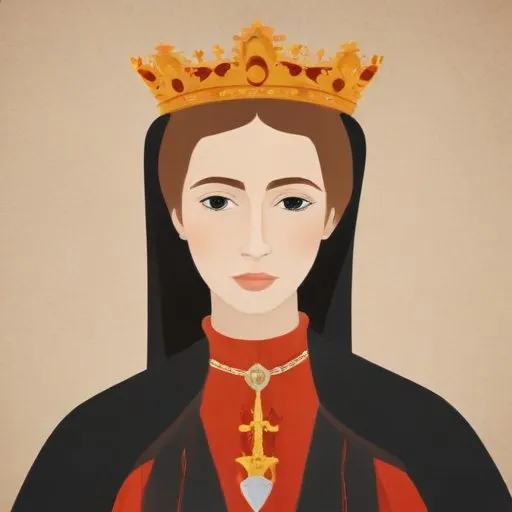
Eleanor of Portugal, Holy Roman Empress: A Life of Royalty and Devotion
A Life of Grandeur and Influence
Eleanor of Portugal, Holy Roman Empress, is renowned for her prestigious title as the consort of Holy Roman Emperor
Frederick III and the mother of Holy Roman Emperor Maximilian I. Born on September 18, 1434, Eleanor's life was filled with grandeur, politics, and devotion, leaving an indelible mark on the historical landscape of Europe.
Early Life and Family Ties
Eleanor was born in Torres Vedras, Portugal, to King Edward of Portugal and his wife,
Eleanor of Aragon. She was the third-eldest daughter, but the untimely deaths of her two older sisters elevated her to the position of eldest surviving daughter. When her father passed away just five days before her fourth birthday, her brother Afonso V succeeded him as king, with their mother serving as regent.
A Marriage of Convenience and Power
Eleanor's marriage to
Frederick III, Holy Roman Emperor, was likely suggested by her aunt,
Isabella of Portugal, Duchess of Burgundy. The arrangement was facilitated by her maternal uncle, Alfonso V, King of Aragon and Naples, who sent artists from his court to paint Eleanor in 1448. The marriage negotiations were finalized in 1451, with Eleanor eventually meeting Frederick in Siena, Italy. The union granted Eleanor the esteemed title of empress, solidifying her position as a prominent figure in European politics.
A Perilous Journey and Royal Duties
During her journey to Italy, Eleanor's fleet was beset by pirates and storms, sparking rumors that she had been lost at sea. Fortunately, she arrived safely and assumed her royal duties alongside Frederick III. As empress, Eleanor played a significant role in supporting her husband's reign, often serving as a mediator and advisor.
Personal Milestones and Legacy
Eleanor gave birth to five children, including Holy Roman Emperor Maximilian I, who would go on to become a prominent figure in European politics. Her maternal influence and guidance played a crucial role in shaping the lives of her children, ensuring the continuation of the Habsburg dynasty.
Pharmaceutical Contributions and Philanthropy
Eleanor was known for her interest in pharmacy and medicine. She supported the development of medicinal gardens and apothecaries, contributing to the advancement of healthcare during her time. Her philanthropic efforts extended to the establishment of hospitals and charitable institutions, earning her a reputation as a compassionate and devoted leader.
Honors and Recognition
Eleanor's life and legacy have been recognized through various honors and tributes. She is remembered as a devoted wife, mother, and ruler, who played a pivotal role in shaping the course of European history.
Historical Context and Impact
Eleanor's life serves as a testament to the intricate web of alliances and marriage strategies that defined the medieval period. Her marriage to Frederick III cemented the bond between the Portuguese and Habsburg dynasties, solidifying the Habsburgs' position as a dominant force in European politics. As a result, Eleanor's influence extended beyond her own lifetime, leaving an indelible mark on the trajectory of European history.
Fun Facts and Trivia
- Eleanor's maternal uncle, Alfonso V, King of Aragon and Naples, was a key facilitator of her marriage to Frederick III.
- During her journey to Italy, Eleanor's fleet was attacked by pirates, sparking rumors of her disappearance.
- Eleanor gave birth to five children, including Holy Roman Emperor Maximilian I.
Visual Timeline and Milestones
| Date |
Milestone |
| September 18, 1434 |
Born in Torres Vedras, Portugal |
| 1448 |
Artists from her uncle's court paint Eleanor |
| 1451 |
Marriage negotiations with Frederick III finalized |
| 1452 |
Meets Frederick III in Siena, Italy |
| 1467 |
Died on September 3 |
FAQ
What was the significance of Eleanor of Portugal, Holy Roman Empress, in European politics?
Eleanor of Portugal, Holy Roman Empress, played a crucial role in shaping European politics through her strategic marriages and alliances. She was a key player in the complex web of relationships between European monarchies and helped to forge important alliances.
How did Eleanor of Portugal, Holy Roman Empress, contribute to the development of the Holy Roman Empire?
Eleanor of Portugal, Holy Roman Empress, was a strong supporter of the Holy Roman Empire and worked tirelessly to promote its interests. She played a key role in mediating disputes between rival factions and helped to maintain stability and unity within the empire.
What were the notable achievements of Eleanor of Portugal, Holy Roman Empress?
Eleanor of Portugal, Holy Roman Empress, was known for her diplomatic skills, which helped to forge alliances with other European powers. She also supported the development of trade and commerce, and her court became a center for cultural and artistic innovation.
What was the relationship between Eleanor of Portugal, Holy Roman Empress, and Emperor Frederick III?
Eleanor of Portugal, Holy Roman Empress, was the wife of Emperor Frederick III and played an important role as his advisor and confidante. She helped to shape his policies and was instrumental in maintaining stability and peace during his reign.
How did Eleanor of Portugal, Holy Roman Empress, support the arts and culture?
Eleanor of Portugal, Holy Roman Empress, was a patron of the arts and commissioned several works of literature, art, and architecture. Her court attracted prominent writers, poets, and artists, and she played a key role in shaping the cultural landscape of 15th-century Europe.