


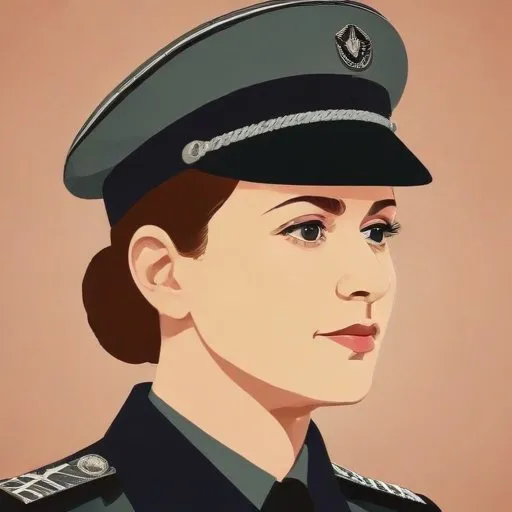
Elfriede Rinkel, a former German Nazi guard, is infamous for her brutal treatment of prisoners at the Ravensbrück concentration camp during World War II. Specifically, she was known for using a specially trained guard dog to torment and abuse the inmates under her supervision.
Born on July 14, 1922, Elfriede Huth, later Rinkel, joined the Nazi Party as a young woman and began working at the Ravensbrück concentration camp in June 1944. As a voluntary dog handler, she received better pay than ordinary supervisors, but her duties came with a sinister twist. Rinkel used her dog to attack and intimidate prisoners, earning her a reputation as one of the most brutal guards at the camp.
Ravensbrück, located in northern Germany, was the largest concentration camp for women during World War II. Between 1942 and 1945, over 132,000 women and children, as well as 20,000 men, were imprisoned within its walls. The camp was notorious for its harsh conditions, forced labor, and brutal treatment of prisoners. During Rinkel's tenure, thousands of prisoners were killed in the gas chambers, making her complicit in one of the darkest chapters of human history.
After the war, Rinkel fled to the United States and married Fred William Rinkel, a German Jew whose family had been murdered in the Holocaust. She kept her past a secret, even from her husband, who died in 2004. For decades, Rinkel lived a seemingly ordinary life, but her dark past eventually caught up with her.
In 2004, the Office of Special Investigations discovered Rinkel's whereabouts, and she was confronted about her past. She confessed to working at Ravensbrück, but downplayed her role, claiming she did not use her dog to attack prisoners and that she never joined the Nazi Party. However, eyewitness accounts and historical records contradict her claims.
Rinkel was deported back to Germany in 2006, where she faced suspicion of Nazi-sponsored persecution. However, all criminal proceedings were eventually dropped, and she was never formally tried for her crimes. Rinkel died in a nursing home in 2018, leaving behind a legacy of controversy and moral ambiguity.
In a rare interview, Rinkel once stated, "I always behaved correctly." However, her actions at Ravensbrück tell a different story. As historian Insa Eschebach noted, "Women were even worse than men in commanding their dogs to brutally attack inmates." Rinkel's case serves as a sobering reminder of the dangers of unchecked power and the importance of confronting our darkest histories.
Rinkel's story is a stark reminder of the atrocities committed during World War II and the need for accountability. Her case also raises questions about the role of women in the Nazi regime and the complexities of moral responsibility. As we reflect on Rinkel's life, we are forced to confront the darker aspects of human nature and the importance of learning from our past.
Elfriede Rinkel's life serves as a cautionary tale about the dangers of unchecked power and the importance of confronting our dark past. Her legacy is a reminder of the atrocities committed during World War II and the need for accountability, even in the face of moral ambiguity.
Born in 1900
Leading the SS and Gestapo, he oversaw the Nazi regime's brutal security apparatus and implemented the "Final Solution," orchestrating the genocide of six million Jews during World War II.
Born in 1889
The dictator of Nazi Germany, responsible for the genocide of six million Jews and millions of other people during World War II, and infamous for his extreme nationalist and anti-Semitic ideology.
Born in 1911
A notorious physician and captain who conducted inhumane experiments on prisoners, particularly twins, during the Holocaust, earning the nickname "Angel of Death".
Born in 1893
A high-ranking Nazi official, he was a decorated World War I fighter pilot and later became a prominent politician, serving as Minister President of Prussia. He's infamous for his role in the Nazi regime and war crimes trials.
Born in 1876
A German naval leader who played a key role in the Kriegsmarine during World War II, overseeing the German U-boat fleet and naval operations. He was a close advisor to Adolf Hitler and implemented the German naval strategy during the war.
Born in 1891
A German naval commander who led the U-boat fleet during World War II and briefly served as President of Germany after Hitler's death, known for his role in the war and its aftermath.
Born in 1893
A German diplomat who served as the Nazi regime's Foreign Minister, orchestrating key alliances and treaties that led to World War II. He was a close associate of Adolf Hitler and played a crucial role in shaping Nazi foreign policy.
Born in 1888
A pioneering tank commander who revolutionized modern warfare with his innovative blitzkrieg tactics, earning him the nickname "Father of the Panzerwaffe".
