


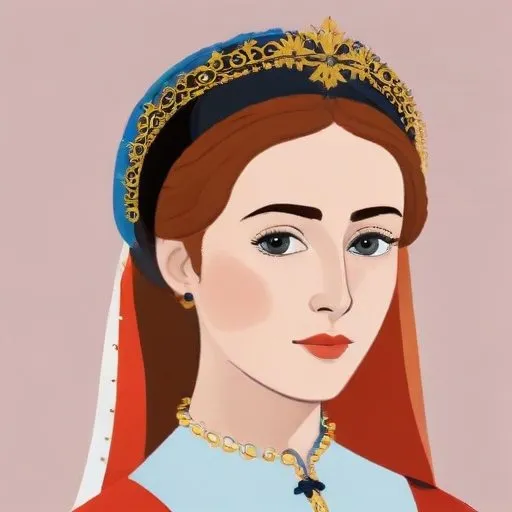
Daughter of King Henry II of France, she was a queen of Spain through her marriage to Philip II, playing a crucial role in 16th-century European politics and diplomacy.
As the third wife of Philip II of Spain, Elisabeth of Valois left an indelible mark on the royal courts of Europe, earning her a revered place in the annals of history. Born in 1546, this French princess would go on to become Queen of Spain, forging a lasting legacy that transcended national borders and royal titles.
Elisabeth was born at the Château de Fontainebleau, the eldest daughter of Henry II of France and Catherine de Medici. Her childhood was spent in the opulent surroundings of the French royal nursery, where she was raised under the watchful eyes of Jean d'Humières and Françoise d'Humières, the governor and governess of the royal children.
It was here that Elisabeth formed a lifelong bond with her future sister-in-law, Mary, Queen of Scots, who was three years her senior. Despite being required to give precedence to Mary, the two women developed a deep and abiding friendship that would endure despite the tumultuous nature of their royal lives.
In 1559, Elisabeth married Philip II of Spain, cementing the Peace of Cateau-Cambrésis between France and Spain. The marriage was a purely diplomatic arrangement, with Elisabeth serving as a symbol of French-Spanish unity.
The ceremony, which took place in Guadalajara, Spain, marked the beginning of Elisabeth's new life as Queen of Spain. Despite the initial awkwardness of a proxy marriage, Elisabeth would go on to win the hearts of the Spanish people with her kindness, generosity, and intelligence.
Elisabeth's tenure as Queen of Spain was marked by her unwavering commitment to the welfare of her subjects. She was known for her charitable works, often intervening on behalf of the poor and the marginalized.
Her lady-in-waiting, Claude de Vineulx, would frequently write to Catherine de Medici, reporting on Elisabeth's health and detailing her numerous acts of kindness. These letters provide a poignant glimpse into the life of a queen who was not only beautiful but also possessed a deep sense of empathy and compassion.
Elisabeth of Valois died on October 3, 1568, at the tender age of 22, leaving behind a legacy that would be felt for generations to come. Her marriage to Philip II of Spain had secured a temporary peace between France and Spain, paving the way for future diplomatic relations between the two nations.
Today, Elisabeth is remembered as a shining example of royal diplomacy, a queen who transcended national borders and royal titles to touch the hearts of those around her. Her story serves as a poignant reminder of the power of kindness, compassion, and empathy in shaping the course of history.
In conclusion, Elisabeth of Valois was more than just a queen – she was a beacon of hope, a symbol of unity, and a testament to the enduring power of kindness and compassion. Her legacy continues to inspire and captivate us to this day, a poignant reminder of the impact one person can have on the world.
Born in 1519
King of France from 1547 to 1559, known for his cultural and artistic patronage, and his role in the Italian Wars.
Born in 1553
The Queen of France who brokered peace between Catholics and Protestants through her marriage, but her lavish lifestyle and scandals sparked the St. Bartholomew's Day massacre.
Born in 1542
The last Scottish monarch of the House of Stuart, she was a Catholic queen who faced Protestant rebellion and was eventually beheaded, sparking a centuries-long rivalry with England. She's known for her tumultuous reign and tragic fate.
Born in 1757
The last Bourbon king of France, ruling from 1824 to 1830, known for his ultra-royalist views and attempts to restore absolute monarchy, leading to the July Revolution.
Born in 1519
King of France from 1547 to 1559, known for his cultural and artistic patronage, and his role in the Italian Wars.
Born in 1785
The last king of the French monarchy before the French Revolution, known for his tragic and mysterious life, including his imprisonment and disputed death.
