


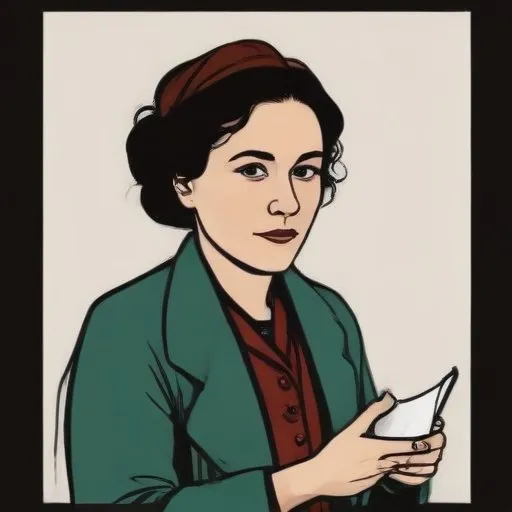
A Kentucky-born writer who crafted poignant poetry and novels that explored the American heartland, particularly the lives of rural women. Her works are celebrated for their lyricism and regional authenticity.
Elizabeth Madox Roberts is renowned for her evocative novels and poems that candidly portray the lives and landscapes of central Kentucky's Washington County. Her distinct, rhythmic prose has captivated readers and critics alike, earning her a place among the leading Southern Renaissance writers of the early 20th century.
Born on October 30, 1881, in Perryville, Kentucky, Roberts grew up in a family of eight children, surrounded by the rolling hills and rural charm of Washington County. Her childhood was marked by a deep connection with nature, which would later become a hallmark of her writing.
Roberts' early life was not without its challenges, however. She was forced to drop out of college due to poor health and spent the next decade teaching elementary school in the Springfield area. It was during this period that she began to hone her writing skills, eventually publishing her first work, a collection of poems titled In the Great Steeps Garden, in 1915.
At the age of 36, Roberts embarked on a journey to the University of Chicago, where she immersed herself in literature and philosophy. This experience not only fulfilled a lifelong dream of acquiring a college education but also deeply influenced her writing style and philosophical outlook.
Roberts' most celebrated works include The Time of Man (1926), My Heart and My Flesh, The Great Meadow (1930), and A Buried Treasure (1931). These novels and stories masterfully capture the essence of rural Kentucky, delving into themes of love, family, and the human condition.
Her writing has been praised by notable figures such as Robert Penn Warren, who hailed The Time of Man as a classic. Lewis P. Simpson, a prominent Southern critic and editor, counted Roberts among the half dozen major Southern Renaissance writers.
Despite the critical acclaim, Roberts' work has yet to achieve widespread recognition. However, her contributions to American literature are undeniable. Three book-length studies of her work, three collections of critical articles, and a thriving Roberts Society that generates numerous papers at its annual conferences are testaments to her enduring legacy.
Roberts' unique voice and perspective have inspired generations of writers and scholars, ensuring her place in the pantheon of American literary greats.
Roberts' writing is characterized by a deep appreciation for the natural world and a profound understanding of human nature. Her works often explore themes of love, family, and the human condition, reflecting her strong sense of empathy and compassion.
Through her writing, Roberts conveyed a strong sense of regional identity and cultural heritage, celebrating the beauty and simplicity of rural Kentucky life.
Elizabeth Madox Roberts' contributions to American literature continue to inspire writers, scholars, and readers alike. Her unique voice and perspective have helped shape the literary landscape of the American South, ensuring her place as a trailblazing figure in the Southern Renaissance.
Today, her works remain a testament to the power of storytelling, offering a glimpse into the lives and landscapes of rural Kentucky and the human experience.
Through her remarkable career, Elizabeth Madox Roberts has left an indelible mark on American literature, ensuring her place as a celebrated and beloved writer of the 20th century.
Born in 1905
A Pulitzer Prize-winning novelist, poet, and literary critic, best known for his novel "All the King's Men", a classic of American literature.
Born in 1899
A leading figure of the New Criticism movement, known for his influential poetry and literary criticism that shaped modern American literature.
Born in 1888
A prominent figure in the New Criticism movement, known for his poetry and literary criticism that emphasized close reading and analysis of texts. He was also a founder of the Kenyon Review literary magazine.
Born in 1917
Developed influential theories on meaning, truth, and the nature of language, challenging traditional notions of reference and interpretation. His work has had a significant impact on the development of analytic philosophy.
Born in 1873
A pioneering modernist writer, credited with influencing 20th-century literature through experimental novels and poetry that explored the human condition. Known for his impressionistic style and complex characters.
