


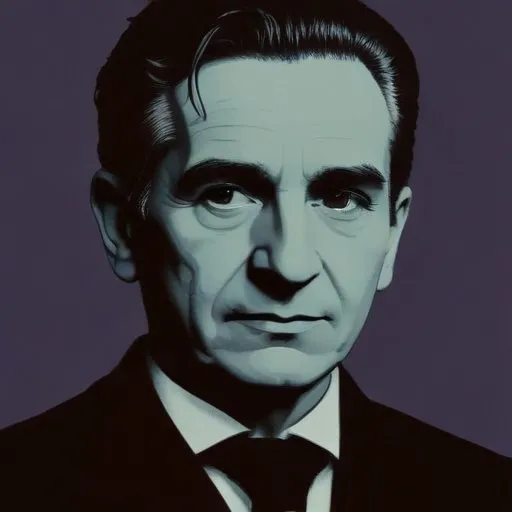
A Romanian-French philosopher and academic who wrote extensively on the human condition, exploring themes of nihilism, pessimism, and the absurdity of life. His works are known for their poetic and provocative style.
Emil Cioran, a Romanian philosopher, aphorist, and essayist, is renowned for his pervasive philosophical pessimism, unique writing style, and thought-provoking aphorisms. His works obsessively explore the human condition, delving into suffering, decay, and nihilism, making him a prominent figure in 20th-century philosophy.
Cioran was born on April 8, 1911, in Rășinari, Szeben County, Kingdom of Hungary (now Rășinari, Sibiu County, Romania). His father, Emilian Cioran, was an Orthodox priest, and his mother, Elvira, was the head of the Christian Women's League. This devout upbringing would later influence his philosophical views on existence and humanity.
At 10, Cioran moved to Sibiu to attend school, and at 17, he enrolled in the Faculty of Literature and Philosophy at the University of Bucharest. It was during this period that he befriended notable figures such as Eugène Ionesco and Mircea Eliade, with whom he would maintain lifelong relationships.
Cioran's philosophical framework is characterized by its emphasis on the inherent meaninglessness of life, the futility of human existence, and the inevitability of decay and suffering. He rejected traditional philosophical optimism, instead embracing a pessimistic worldview that emphasized the darker aspects of human nature.
His work was deeply influenced by various philosophers, including Friedrich Nietzsche, Arthur Schopenhauer, and Martin Heidegger. Cioran's concept of "decay" was particularly shaped by his fascination with the works of Lev Shestov, a Russian philosopher who believed that life is arbitrary.
Cioran's literary output is remarkable for its depth and diversity. Some of his notable works include:
These works showcase Cioran's unique writing style, which blended aphorisms, essays, and philosophical inquiry to create a distinctive literary voice.
Cioran's philosophical ideas have had a profound impact on modern thought, influencing a wide range of disciplines, from literature to psychology. His pessimistic worldview has resonated with many, offering a refreshing counterpoint to the prevailing optimism of modern society.
Today, Cioran is recognized as one of the most important philosophers of the 20th century, and his work continues to inspire new generations of thinkers, writers, and artists.
In 1937, Cioran moved to Paris, where he lived in seclusion with his partner, Simone Boué, until his death in 1995. This period of solitude allowed him to focus on his writing, producing some of his most influential works.
Despite his reclusive nature, Cioran remained a prominent figure in French intellectual circles, counting notable writers and philosophers, such as Jean-Paul Sartre and Gabriel Marcel, among his acquaintances.
Cioran's pessimistic views and his rejection of traditional philosophical optimism have led to controversy and criticism from some quarters. Some have accused him of promoting a bleak and nihilistic worldview, while others have hailed him as a prophet of existential despair.
Despite these criticisms, Cioran's work remains widely admired for its intellectual honesty, its willingness to confront the darker aspects of human existence, and its unflinching commitment to the pursuit of truth.
Some of Cioran's most memorable quotes include:
These quotes capture the essence of Cioran's philosophy, highlighting his unique blend of pessimism, wit, and intellectual curiosity.
Emil Cioran's life and work serve as a testament to the power of philosophical inquiry, demonstrating that even in the darkest depths of human existence, there lies a profound beauty and a deep wisdom waiting to be uncovered.
Born in 1909
A French philosopher and mystic who merged spirituality with social activism, advocating for the rights of the working class and promoting a sense of compassion and empathy. Her philosophical ideas continue to influence modern thought on morality, politics, and spirituality.
Born in 1889
A German philosopher and academic who explored the meaning of existence, time, and human existence, influencing 20th-century philosophy with his concept of "Being-in-the-world".
Born in 1905
Existentialist philosopher and playwright who argued that humans have complete freedom to choose their actions and create their own meaning in life, influencing modern thought on morality and individual responsibility.
Born in 1913
A French novelist, philosopher, and journalist who wrote influential works like "The Stranger" and "The Plague", exploring absurdism and the human condition.
Born in 1788
A pessimistic philosopher who wrote about the human condition, emphasizing the struggles and sufferings of life, and is famous for his concept of the "will to life".
Born in 1813
A Danish philosopher and author who is considered the father of existentialism, known for his philosophical and theological writings that emphasized individualism and subjective experience.
Born in 1909
A Romanian-French playwright and critic, known for his absurdist plays that ridicule the human condition, exploring the futility of communication and the search for meaning in a seemingly meaningless world.
