


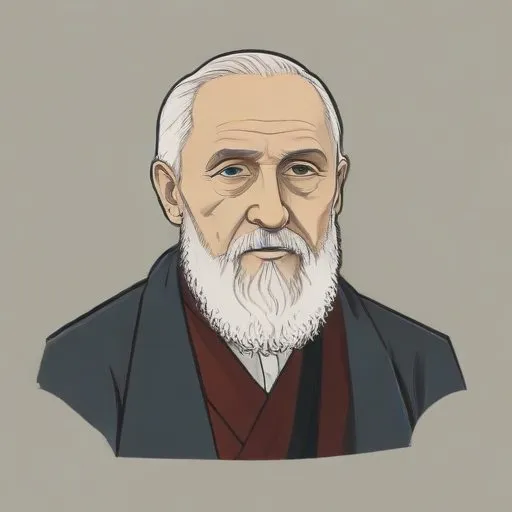
A Russian philosopher who rejected rationalism and emphasized the individual's existential experience, exploring the absurdity and mystery of life. He's known for his critiques of traditional philosophy and his concept of "philosophy of tragedy".
Lev Shestov, a Russian existentialist and religious philosopher, is renowned for his scathing critiques of philosophic rationalism and positivism. Through his work, he advocated for a movement beyond reason and metaphysics, arguing that these are incapable of conclusively establishing truth about ultimate problems, including the nature of God or existence.
Born Yeguda Lev Shvartsman in Kiev, Ukraine, in 1866, Shestov came from a Jewish family. His education was marked by frequent clashes with authority, leading him to study law and mathematics at the Moscow State University. However, his dissertation was rejected by the St. Vladimirs Imperial University of Kiev due to its revolutionary tendencies, preventing him from becoming a doctor of law.
Shestov's magnum opus, Athens and Jerusalem (1930-1937), is a testament to his philosophical contributions. In it, he challenged the notion that reason and metaphysics can provide definitive answers to life's fundamental questions. Instead, he proposed an existential and religious approach, emphasizing the role of faith and individual experience.
Shestov's ideas have had a significant impact on modern thought, influencing thinkers such as Edmund Husserl, Benjamin Fondane, Rachel Bespaloff, and Georges Bataille. His work has also been associated with the label "antiphilosophy," a term that reflects his rejection of traditional philosophical frameworks.
In 1921, Shestov emigrated to France, where he befriended and influenced prominent thinkers. He lived in Paris until his death in 1938, leaving behind a legacy that continues to shape philosophical discourse.
Shestov's critiques of rationalism and positivism have made him a pioneer in existential and religious philosophy. His work continues to inspire and challenge scholars, ensuring his place as one of the most important thinkers of the 20th century.
Shestov's ideas have been compared to those of Friedrich Nietzsche and Søren Kierkegaard, two philosophers who also challenged traditional philosophical frameworks. His work has also been associated with Russian writers such as Fyodor Dostoyevsky, Leo Tolstoy, and Anton Chekhov, reflecting his interest in the intersection of philosophy and literature.
Shestov's cousin, Nicholas Pritzker, was a lawyer who emigrated to Chicago and became the patriarch of the prominent Pritzker family. This family connection highlights Shestov's complex and multifaceted personal life, which was marked by intellectual engagements and personal relationships that shaped his philosophical ideas.
Born in 1889
A German philosopher and academic who explored the meaning of existence, time, and human existence, influencing 20th-century philosophy with his concept of "Being-in-the-world".
Born in 1813
A Danish philosopher and author who is considered the father of existentialism, known for his philosophical and theological writings that emphasized individualism and subjective experience.
Born in 1906
A Lithuanian-French philosopher who developed the concept of "ethics as first philosophy," emphasizing the importance of responsibility towards others and the face-to-face encounter. His work has influenced contemporary thought on morality, justice, and human rights.
Born in 1905
Existentialist philosopher and playwright who argued that humans have complete freedom to choose their actions and create their own meaning in life, influencing modern thought on morality and individual responsibility.
Born in 1913
A French novelist, philosopher, and journalist who wrote influential works like "The Stranger" and "The Plague", exploring absurdism and the human condition.
Born in 1908
A pioneering feminist philosopher who wrote extensively on ethics, politics, and gender, famously arguing that "one is not born, but rather becomes, a woman."
