


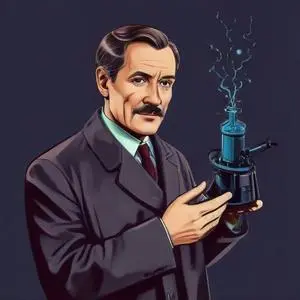
A German physician and physiologist who pioneered the field of electrophysiology, discovering the electrical impulses that control muscle movement and founding the field of neurophysiology.
Emil du BoisReymond, a German physiologist, is renowned for his groundbreaking discovery of nerve action potential and his instrumental role in developing experimental electrophysiology. His work in the field of physiology earned him great esteem during the latter half of the 19th century, making him a pioneer in the field.
Born on November 7, 1818, in Berlin, Germany, du BoisReymond came from a family of modest means. His father, a poor immigrant from Neuchâtel, and his mother, a Berliner of prominent Huguenot origin, instilled in him a strong sense of determination and perseverance. Du BoisReymond's early education at the French College in Berlin laid the foundation for his future academic pursuits.
In 1838, du BoisReymond enrolled in the University of Berlin, where he initially struggled to find his academic niche. However, under the guidance of Johannes Peter Müller, a prominent professor of anatomy and physiology, du BoisReymond discovered his passion for physiology. Müller's influence and du BoisReymond's dedication led to his appointment as Müller's assistant in physiology in 1840.
It was during this time that du BoisReymond received a copy of Carlo Matteucci's essay on the electric phenomena of animals, which sparked his interest in electrophysiology. This marked the beginning of du BoisReymond's life-long research in the field, culminating in his discovery of nerve action potential and the development of experimental electrophysiology.
Emil du BoisReymond's pioneering work in electrophysiology has had a profound impact on modern society. His discoveries have led to significant advancements in various fields, including:
Today, Emil du BoisReymond is remembered as a trailblazer in the field of physiology, and his contributions continue to inspire new generations of scientists and researchers.
Born in 1821
A 19th-century physician and physicist who made significant contributions to the fields of electromagnetism, thermodynamics, and the physiology of human perception, particularly in the study of vision and hearing.
Born in 1821
A pioneer in modern medicine, he founded the field of social medicine, emphasizing the importance of social and environmental factors on health, and made significant contributions to cellular pathology.
Born in 1834
A German biologist, physician, and philosopher who coined the term "ecology" and made significant contributions to the field of evolutionary biology, including the recapitulation theory.
Born in 1816
Developed the first device to measure blood pressure and made significant contributions to the field of physiology, particularly in the areas of respiration and circulation.
Born in 1832
Founded the first formal laboratory of psychology, establishing psychology as a separate field of study and developing the concept of structuralism, which focuses on breaking down mental processes into basic components.
