


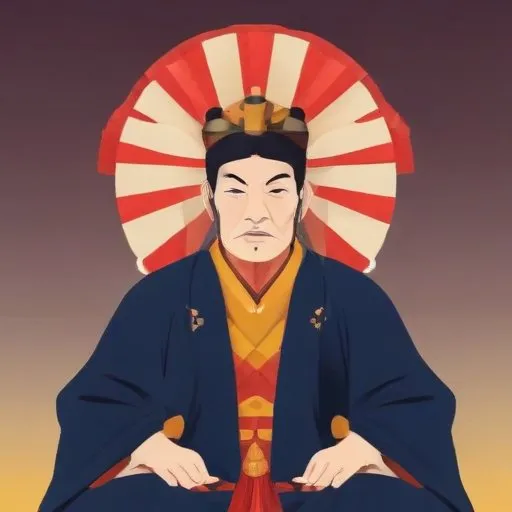
The 89th emperor of Japan, ruling from 1246 to 1260, known for his efforts to reform the imperial court and restore its power during a time of decline. He's also famous for his poetry and patronage of the arts.
Emperor GoFukakusa, the 89th emperor of Japan, is renowned for his remarkable reign that spanned from 1246 to 1260, leaving an indelible mark on the country's imperial history. This 13th-century sovereign, named after the 9th-century Emperor Ninmyō, is often referred to as the "Later Emperor Fukakusa," symbolizing his connection to the revered monarch.
Born on June 28, 1243, as Prince Hisahito, the second son of Emperor GoSaga, GoFukakusa was destined for greatness. His ascension to the Chrysanthemum Throne marked the beginning of a new era in Japanese politics and culture. During his reign, the emperor focused on consolidating power, strengthening the imperial system, and promoting the arts.
Emperor GoFukakusa's personal life was filled with love and loss. He married Empress Saionji Fujiwara Kimiko, daughter of Saionji Saneuji, and had several children, including:
These relationships not only secured the continuation of the imperial line but also solidified alliances with prominent noble families.
Emperor GoFukakusa was a patron of the arts, and his reign saw a resurgence of cultural and literary activities. He supported the development of classical Japanese literature, poetry, and calligraphy, which flourished during this period. His court also witnessed the emergence of prominent scholars, poets, and artists, who contributed significantly to Japan's cultural heritage.
Emperor GoFukakusa's impact on Japanese history is multifaceted. He not only consolidated imperial power but also promoted cultural development, which paved the way for the country's Golden Age of literature and arts. His legacy is a testament to the enduring power of the Japanese monarchy and the significance of cultural patronage.
As the 13th-century sovereign's reign came to a close, his influence on Japanese society continued to grow. His descendants went on to occupy the Chrysanthemum Throne, ensuring the continuation of the imperial line. Today, Emperor GoFukakusa remains an important figure in Japanese history, revered for his wisdom, cultural patronage, and commitment to the imperial system.
In conclusion, Emperor GoFukakusa's remarkable reign, marked by his cultural achievements, imperial consolidation, and family relationships, has left an indelible mark on Japanese history. As we reflect on his life and legacy, we are reminded of the significance of cultural patronage, the importance of imperial duty, and the enduring power of the Japanese monarchy.
Born in 1596
The 108th emperor of Japan, ruling from 1611 to 1623, known for his cultural achievements, particularly in poetry and art, and for establishing the imperial court's independence from the shogunate.
Born in 1654
The 112th emperor of Japan, ruling from 1663 to 1687, known for his cultural and artistic achievements, particularly in poetry and calligraphy. He also reformed the imperial court and promoted Confucianism.
Born in 1675
The 113th emperor of Japan, who ruled from 1687 to 1709, is most known for his cultural achievements, particularly in poetry and calligraphy, and for his role in promoting the arts during the Genroku era. He was a patron of the famous poet Matsuo Bash? and encouraged the development of haiku poetry.
Born in 1702
The 18th emperor of Japan, ruling from 1709 to 1745, known for his cultural achievements, particularly in poetry and calligraphy. He also reformed the imperial court and promoted Confucianism.
Born in 1543
Unified Japan's warring states, establishing a dynasty that ruled for over 250 years, and is revered as a brilliant military strategist and statesman.
Born in 1579
The second shogun of the Tokugawa dynasty, who solidified the family's rule and established a rigid feudal system in Japan, known for his military campaigns and administrative reforms.
Born in 1604
The shogun who ruled Japan from 1623 to 1651, known for isolating Japan from the rest of the world and establishing a rigid feudal system.
