


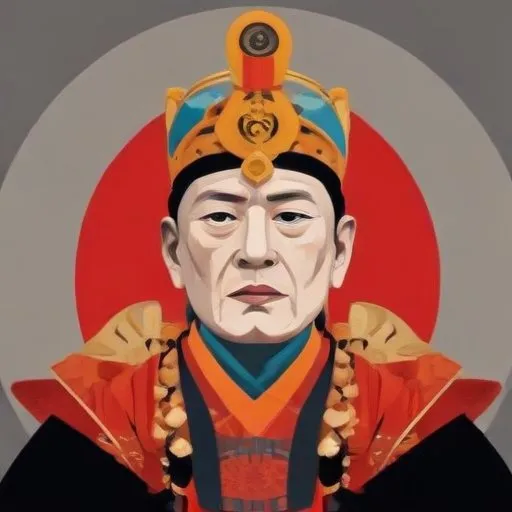
The 15th-century Japanese monarch who reigned during a period of civil war and is remembered for his attempts to restore imperial authority and promote cultural revival. He's also known for his patronage of the arts, particularly Noh theater.
Emperor Gimachi, known for his reign from 1557 to 1586, marked a significant transition between the Sengoku period and the Azuchi-Momoyama period in Japanese history. During his reign, he oversaw the coronation ceremonies, which were made possible by the financial support of prominent daimyos, including Mōri Motonari.
Emperor Gimachi, also known as Michihito, was the first son of Emperor Go-Nara. His mother, Lady Naishin-no-suke Madenokōji Fujiwara Fusako (d. 1580), later known as Seikōin, was a lady-in-waiting to the emperor. Gimachi's family tree is filled with prominent figures, including his daughter, Princess Eikō (1541-1551), and his eldest son, Imperial Prince Masahito (1552-1586).
Gimachi's reign began in 1557, following the death of his father, Emperor Go-Nara. In 1560, during the Eiroku era, he was formally proclaimed emperor, with the coronation ceremonies financed by prominent daimyos. During his reign, he witnessed significant events, including the Battle of Okehazama in 1560, where Imagawa Yoshimoto's forces were defeated by Oda Nobunaga's armies.
Gimachi's family played a crucial role in shaping Japanese history. His son, Imperial Prince Masahito, had a son of his own, Imperial Prince Kazuhito, who would later become Emperor Go-Yōzei. Go-Yōzei posthumously elevated his grandfather's rank, allowing him to enjoy the title of emperor, despite his untimely death.
Gimachi's reign marked a significant transition between the Sengoku period and the Azuchi-Momoyama period, setting the stage for the rise of prominent figures like Oda Nobunaga and Toyotomi Hideyoshi. His reign also highlighted the growing importance of daimyos in Japanese politics, as they began to play a more prominent role in financing and supporting the imperial court.
Despite being a relatively short-lived article, it is clear that Emperor Gimachi played a pivotal role in Japanese history, marking a significant transition between two prominent periods. His legacy continues to influence Japanese politics and culture, making him an important figure to study and remember.
Born in 1543
Unified Japan's warring states, establishing a dynasty that ruled for over 250 years, and is revered as a brilliant military strategist and statesman.
Born in 1537
A powerful Japanese warlord who unified Japan's warring states and led two invasions of Korea, leaving a lasting legacy in Japanese history. He's also known for his iconic Osaka Castle.
Born in 1534
A powerful Japanese daimyo who unified much of Japan's warring states, introducing firearms and modern warfare tactics, and is considered one of Japan's most important historical figures.
Born in 1891
A Japanese politician who served as Prime Minister during World War II, known for his role in leading Japan into the war and his attempts to negotiate a peace settlement. He is also infamous for his involvement in the Nanjing Massacre.
