


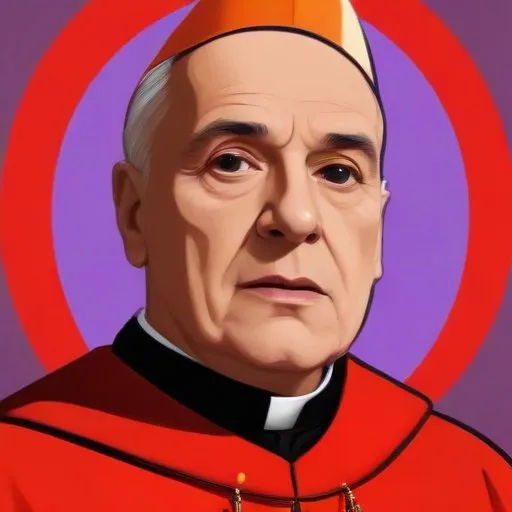
A 18th-century Italian cardinal who played a crucial role in re-establishing the Catholic Church's power and influence after the French Revolution, and is known for his diplomatic skills and reforms.
Ercole Consalvi, a 18th-century Italian cardinal, is renowned for his instrumental role in reinstating the legitimacy of the divine right of kings, following the tumultuous period of Napoleon's reign. Twice serving as the Cardinal Secretary of State for the Papal States, Consalvi's astute diplomacy and unyielding commitment to the monarchic principle cemented his position as a pivotal figure in the post-Napoleonic era.
Born on June 8, 1757, in Rome, Consalvi descended from the noble family of Brunacci of Pisa. Following his father's death in 1763, he was placed under the care of Cardinal Andrea Negroni. His education at the college of the Piarists (1771-1776) and the seminary founded by Cardinal Henry Benedict Stuart (also known as Cardinal York) laid the foundation for his future success.
Upon completing his seminary studies in 1776, Consalvi took minor orders and became a member of a congregation responsible for municipal affairs. He subsequently studied jurisprudence and ecclesiastical history at the Pontifical Ecclesiastical Academy in Rome (1776-1782), where he was mentored by the Jesuit scholar, Zaccaria. His doctorates in civil and canon law from La Sapienza University (1789) further solidified his position as a rising star in the Roman Curia.
Consalvi's appointment as Cardinal Secretary of State in 1800 marked the beginning of his illustrious career as a diplomat and statesman. He played a crucial role in negotiating the Treaty of Tolentino (1801) with Napoleon, which, although criticized for its concessions, helped maintain the sovereignty of the Papal States.
Following Napoleon's defeat, Consalvi's diplomatic prowess was instrumental in reinstating the legitimacy of the divine right of kings. At the Congress of Vienna (1814-1815), he effectively lobbied for the restoration of the monarchies and the Papal States' sovereignty. His second tenure as Cardinal Secretary of State (1817-1824) saw him continue to promote the interests of the Papal States and reinforce the legitimacy of the monarchic institution.
Ercole Consalvi's unwavering commitment to the divine right of kings and his diplomatic acumen have left an indelible mark on European history. His legacy serves as a testament to the power of effective diplomacy and the importance of upholding the principles of legitimacy and sovereignty.
Ercole Consalvi's remarkable career serves as a shining example of the impact one individual can have on shaping the course of history. His legacy continues to inspire future generations of diplomats, statesmen, and historians alike.
Born in 1876
The leader of the Catholic Church from 1939 to 1958, known for his controversial role during World War II, particularly in regards to the Holocaust. He is also remembered for his encyclicals on social justice and liturgical reforms.
Born in 1810
The first pope to fully embrace modernity, he issued the groundbreaking encyclical Rerum Novarum, which addressed social justice and workers' rights, shaping the Catholic Church's stance on social issues.
Born in 1504
Leader of the Catholic Church during the Counter-Reformation, he excommunicated Queen Elizabeth I and played a key role in the Council of Trent.
Born in 1742
The head of the Catholic Church from 1800 to 1823, known for his opposition to Napoleon Bonaparte and his restoration of the Papal States.
Born in 1554
Established the Congregation for the Propagation of the Faith, a missionary organization that aimed to spread Catholicism globally, and standardized the papal conclave process.
Born in 1499
Reigned from 1559 to 1565, this Pope oversaw the final session of the Council of Trent, shaping Catholic doctrine and practice for centuries to come. He also commissioned the construction of the Sistine Chapel's dome.
