


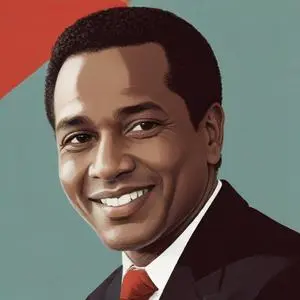
First Prime Minister of Trinidad and Tobago, leading the country to independence from British colonial rule and shaping its modern identity. He's also a renowned historian, authoring influential works on slavery and capitalism.
As the first Prime Minister of Trinidad and Tobago, Eric Williams is widely regarded as the Father of the Nation, having successfully led the country to majority rule, independence, and republic status. His remarkable journey, marked by unwavering dedication and perseverance, has left an indelible mark on the nation's history.
Born on September 25, 1911, to Thomas Henry Williams and Eliza Frances Boissiere, Eric Williams was raised in a devout Roman Catholic family. His early education at Tranquillity Boys Intermediate Government School and Queens Royal College in Port of Spain laid the foundation for his academic excellence. A brilliant student, he won an island scholarship in 1932, which enabled him to attend St. Catherine's Society, Oxford, where he earned a first-class honors degree in history and ranked first among his peers in 1935.
Williams' academic prowess continued to flourish as he earned his doctorate in 1938. His groundbreaking research on the relationship between capitalism and slavery led to the publication of his seminal work, "Capitalism and Slavery," in 1944. This influential book not only established him as a prominent Caribbean historian but also challenged prevailing notions about the transatlantic slave trade.
Upon returning to Trinidad and Tobago in 1948, Williams became increasingly involved in politics, eventually founding the People's National Movement (PNM) in 1956. His charisma, vision, and unwavering commitment to the nation's growth propelled the PNM to victory in the 1956 general elections, marking the beginning of majority rule in Trinidad and Tobago.
Eric Williams' remarkable legacy extends beyond his impressive political achievements. His tireless efforts to promote national pride, cultural identity, and economic development have inspired generations of Trinidadians and Tobagonians. As a testament to his enduring impact, the Eric Williams Memorial Collection at the University of the West Indies serves as a valuable repository of historical documents and memorabilia.
In his autobiography, "Inward Hunger," Williams shared his experiences as a student, historian, and politician. He also left behind a treasure trove of quotes, including: "The future belongs to those who believe in the beauty of their dreams."
Williams' remarkable journey unfolded against the backdrop of colonialism, decolonization, and the struggle for independence in the Caribbean. His accomplishments can be compared to those of other notable regional leaders, such as Jamaica's Norman Manley and Barbados' Grantley Adams, who also played critical roles in shaping the destiny of their respective nations.
Through his unwavering dedication, Eric Williams has left an indelible mark on Trinidad and Tobago's history. As the nation continues to evolve, his vision, leadership, and legacy remain a beacon of inspiration for generations to come.
In conclusion, Eric Williams' remarkable life and achievements serve as a testament to the power of vision, perseverance, and dedication. As a nation, Trinidad and Tobago continues to draw inspiration from his legacy, striving to build a brighter future for all its citizens.
Born in 1910
Led the country to independence from British colonial rule and served as its first prime minister, implementing policies to promote economic growth and social welfare.
Born in 1920
Led the country to independence from British colonial rule in 1966, becoming a national hero and symbol of sovereignty. He's also credited with modernizing the island's economy and infrastructure.
Born in 1901
A pioneering Marxist theorist and journalist who wrote extensively on cricket, politics, and culture, blending sports and social commentary in a unique and influential way.
Born in 1924
The 4th Prime Minister of Jamaica, a champion of democratic socialism, who implemented policies to reduce poverty and increase self-reliance, and was a strong advocate for Third World solidarity.
93 Years Old
The 5th Prime Minister of Trinidad and Tobago, a prominent figure in the country's politics, known for his efforts to strengthen the economy and promote social justice. He played a significant role in shaping the nation's development.
