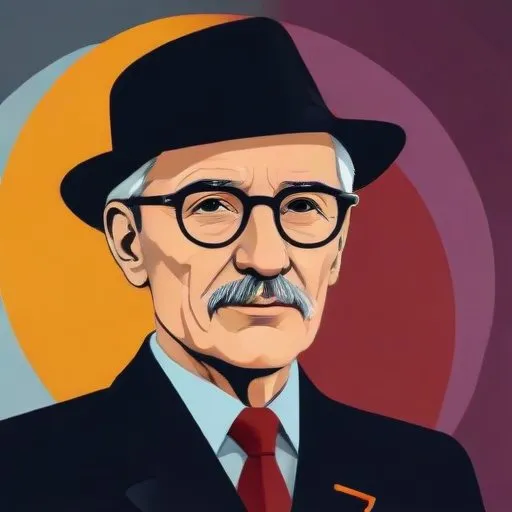
Erich von Drygalski: The Polar Pioneer Who Charted the Uncharted
The Man Behind the Maps
Erich von Drygalski is renowned for leading the first German South Polar expedition to Antarctica, uncovering new territories and mapping the unexplored regions of the frozen continent. Between 1901 and 1903, his expedition on the ship Gauss not only expanded our understanding of Antarctica but also paved the way for future polar research.
Early Life and Education
Born on February 9, 1865, in Königsberg, East Prussia, Drygalski was drawn to mathematics and natural sciences from an early age. He studied at the University of Königsberg, Bonn, Berlin, and Leipzig, eventually graduating with a doctorate thesis on ice shields in Nordic areas.
Early Expeditions and Career Highlights
Drygalski's early expeditions between 1891 and 1893, sponsored by the Society for Geoscience of Berlin, took him to Western Greenland, where he wintered during the winter of 1892-1893. This experience earned him a habilitation in geography and geophysics in 1889. By 1898, he became an associate professor, and in 1899, an extraordinary professor for geography and geophysics in Berlin.
The Gauss Expedition: A Groundbreaking Journey
The Gauss expedition, which set sail from Kiel in 1901, was Drygalski's most notable achievement. Despite being trapped by ice for nearly fourteen months, the expedition discovered new territory in Antarctica, including the Kaiser Wilhelm II Land and the Gaussberg. Drygalski's meticulous documentation of the expedition's findings was later published in twenty volumes and two atlases, cementing his legacy as a polar pioneer.
Awards and Recognition
Drygalski's contributions to polar research were recognized with the 1933 Royal Geographical Society's Patrons Medal, a testament to his tireless efforts in exploring the unknown.
Legacy and Impact
Drygalski's work not only expanded our understanding of Antarctica but also paved the way for future generations of polar researchers. His expedition's findings continue to influence modern climate research, glaciology, and geophysics.
Fun Facts and Trivia
- Drygalski was one of the first scientists to recognize the importance of Antarctica in understanding global climate patterns.
- He was an accomplished cartographer and created detailed maps of the regions he explored.
- Drygalski's expedition collected over 10,000 botanical specimens, which were later studied and classified by botanists.
A Lasting Legacy
Erich von Drygalski's pioneering spirit, unwavering dedication, and groundbreaking research have left an indelible mark on the world of polar science. As we continue to explore and understand the complexities of our planet, Drygalski's legacy serves as a beacon of inspiration for future generations of scientists and explorers.
FAQ
What was Erich von Drygalskis most significant scientific contribution?
Erich von Drygalski was a German geographer and geophysicist who made significant contributions to the fields of glaciology and geophysics, particularly through his research on the Antarctic ice sheet and the Earths magnetic field.
How did Erich von Drygalskis expeditions expand our knowledge of Antarctica?
Erich von Drygalskis expeditions to Antarctica in the early 20th century greatly expanded our knowledge of the continents geography, geology, and climate, and helped to pave the way for later scientific research.
What was Erich von Drygalskis role in the development of modern geophysics?
Erich von Drygalski played a significant role in the development of modern geophysics, particularly through his work on seismology and the Earths magnetic field, which helped to establish geophysics as a distinct scientific discipline.
What awards and honors did Erich von Drygalski receive for his scientific contributions?
Erich von Drygalski received numerous awards and honors for his scientific contributions, including the Royal Geographical Societys Founders Medal and the German Geophysical Societys Emil Wiechert Medal.
What is Erich von Drygalskis legacy in the field of geophysics?
Erich von Drygalskis legacy in the field of geophysics is that of a pioneering scientist who helped to establish geophysics as a distinct scientific discipline and expand our understanding of the Earths physical processes.