


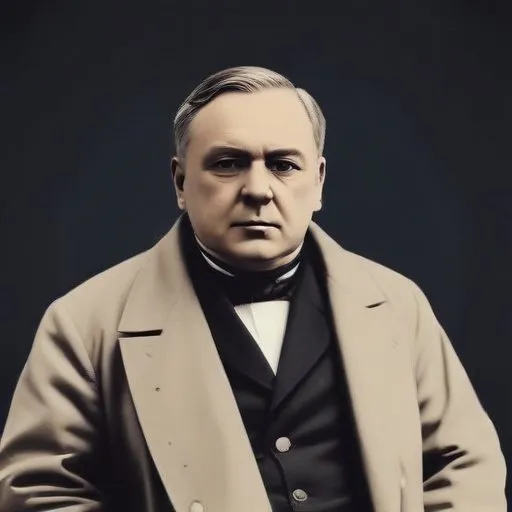
A French physician and explorer who led several expeditions to the Antarctic and Arctic regions, making significant contributions to the field of geography and cartography.
Jean-Baptiste Charcot was a French scientist, medical doctor, and polar explorer who embarked on a series of daring expeditions to the Antarctic and Arctic regions, expanding our knowledge of these unforgiving landscapes. He is renowned for leading the French Antarctic Expedition (1904-1907) and the subsequent expedition to the Bellingshausen Sea and Amundsen Sea (1908-1910), which resulted in the discovery of Loubet Land, Marguerite Bay, and Mount Boland.
Born on July 15, 1867, in Neuilly-sur-Seine, France, Charcot was the son of the famous neurologist Jean-Martin Charcot. Growing up in a family of intellectuals, Charcot was instilled with a passion for science and exploration from a young age. His father's influence and the stories of explorers like Ernest Shackleton and Robert Falcon Scott ignited a fire within him to venture into the unknown.
Charcot's first expedition, the French Antarctic Expedition (1904-1907), took him to the west coast of Graham Land, where he explored the Palmer Archipelago and Loubet Coast. During this expedition, he reached Adelaide Island in 1905 and collected valuable data on the region's geology, geography, and wildlife.
His subsequent expedition (1908-1910) aimed to explore the Bellingshausen Sea and Amundsen Sea. This journey proved fruitful, with Charcot discovering Loubet Land, Marguerite Bay, and Mount Boland. He also charted the coastline of Graham Land and explored the surrounding islands.
Charcot was not only an accomplished explorer but also a talented athlete. He participated in various sports, including sailing, which earned him two silver medals at the 1900 Summer Olympics.
In the 1920s and 1930s, Charcot continued to explore the polar regions, visiting Eastern Greenland and Svalbard. Tragically, his life was cut short when his ship, Pourquoi Pas?, was wrecked in a storm off the coast of Iceland on September 16, 1936.
Charcot's legacy extends beyond his expeditions. He inspired a new generation of explorers and scientists, and his discoveries paved the way for further research in the polar regions. Today, he is remembered as one of the most daring and accomplished polar explorers of his time.
To commemorate Charcot's achievements, two monuments were erected in Reykjavik, Iceland, one in 1936 and another in 1952. The lichen genus Charcotiana was named in his honor in 2014, a testament to his enduring impact on the scientific community.
Born in 1868
Led a British expedition to the South Pole, racing against a Norwegian team, and tragically perished on the return journey. He is remembered for his bravery and sacrifice in the pursuit of scientific discovery.
Born in 1872
First person to reach the South Pole, leading a Norwegian expedition in 1911, and a pioneer in Arctic and Antarctic exploration.
Born in 1874
Led expeditions to the Antarctic, famously surviving a disastrous shipwreck and trekking to safety, earning a legendary reputation for bravery and leadership.
Born in 1744
A French soldier, biologist, and academic who developed a theory of inheritance of acquired characteristics, proposing that organisms adapt to their environment and pass on those traits to their offspring.
Born in 1790
A French naval officer who led expeditions to the Pacific and Antarctica, discovering new lands and mapping uncharted territories. He's credited with discovering the Venus de Milo statue.
Born in 1681
Led a series of expeditions that mapped much of the Arctic coast of Siberia and discovered several islands, including the Bering Islands. He also led the first European expedition to sight mainland Alaska.
Born in 1800
Led British expeditions to the Arctic, discovering the North Magnetic Pole and the Ross Sea in Antarctica. He mapped much of the region, expanding knowledge of the polar regions.
