


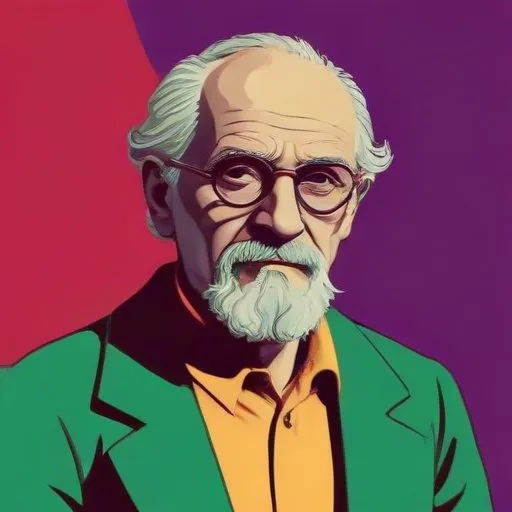
Developed a formal system of deontic logic, which deals with moral obligations and permissions, and made significant contributions to the field of ethics. His work laid the foundation for modern deontic logic and its applications in philosophy, law, and computer science.
Ernst Mally, an Austrian analytic philosopher, is primarily known for his groundbreaking contributions to deontic logic, a subfield of logic that deals with obligations, permissions, and prohibitions. He is also recognized for his work in metaphysics, particularly his introduction of the dual predication approach, which distinguishes between two kinds of predication.
Mally was born on October 11, 1879, in Kranj, Austria-Hungary (now in Slovenia), to a Slovene father who identified with Austrian German culture. He spent his early years in Ljubljana, where he attended the prestigious Ljubljana German-language Gymnasium. During this time, he developed an interest in philosophy and became a fervent supporter of the Pan-German nationalist movement.
In 1898, Mally enrolled in the University of Graz, where he studied philosophy under the supervision of Alexius Meinong, a renowned philosopher. He also pursued studies in physics and mathematics, specializing in formal logic. Mally graduated in 1903 with a doctoral thesis entitled Untersuchungen zur Gegenstandstheorie des Messens (Investigations in the Object Theory of Measurement).
Mally's most significant contributions lie in the field of deontic logic, where he introduced the concept of "ought" and developed a formal system for dealing with obligations, permissions, and prohibitions. His work in metaphysics, particularly the dual predication approach, has had a lasting impact on the field.
Mally's work has had a profound influence on various fields, including philosophy, logic, and ethics. His contributions to deontic logic have shaped the way philosophers and scholars think about obligations, permissions, and prohibitions, and have had practical applications in fields such as law, politics, and artificial intelligence.
Ernst Mally's legacy continues to inspire and influence philosophers, logicians, and scholars to this day. His pioneering work in deontic logic and metaphysics has left an indelible mark on the academic community, and his contributions remain a testament to his intellectual rigor and dedication to philosophical inquiry.
Born in 1859
A pioneer of phenomenology, this mathematician and philosopher developed a rigorous method to study conscious experience, seeking to understand how we perceive and interpret the world around us.
Born in 1889
A German philosopher and academic who explored the meaning of existence, time, and human existence, influencing 20th-century philosophy with his concept of "Being-in-the-world".
Born in 1889
A philosopher who challenged traditional philosophy by emphasizing the importance of language and its limits, and is famous for his philosophical ideas on logic, reality, and the nature of meaning.
Born in 1872
A renowned thinker who made significant contributions to mathematics, philosophy, and social commentary, known for his influential writings on logic, ethics, and politics. He's a prominent figure in shaping modern intellectual thought.
Born in 1848
Developed a formal system of logic and introduced modern mathematical notation, laying the groundwork for modern logic, mathematics, and computer science.
Born in 1891
Developed logical positivism, a philosophical movement that emphasized scientific evidence and rejected metaphysics, and made significant contributions to the fields of philosophy of language, philosophy of science, and epistemology.
Born in 1882
Developed the Vienna Circle's logical positivism, a philosophical movement that emphasized empirical evidence and rejected metaphysics. They also made significant contributions to the philosophy of science and ethics.
Born in 1879
Austrian mathematician and philosopher who made significant contributions to topology, set theory, and philosophy of mathematics, and is known for his work on the Hahn-Banach theorem.
