


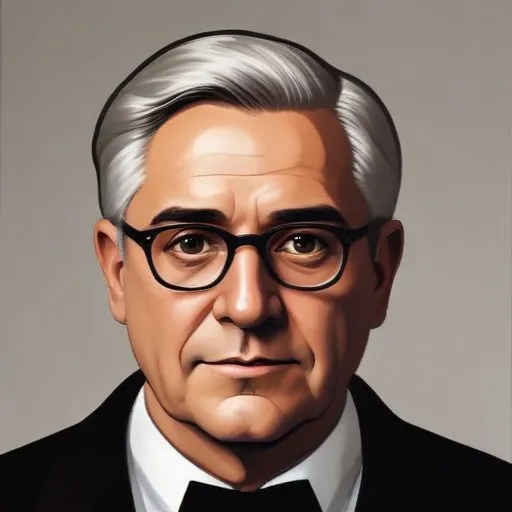
A German zoologist who discovered and described several species of land snails and slugs, making significant contributions to malacology.
Ernst Marcus, a renowned German zoologist, is best known for his groundbreaking contributions to the field of zoology, particularly in Brazil, where he spent most of his career. As the former occupant of the chair of zoology at the University of São Paulo, Marcus co-founded the Oceanographic Institute of the University of São Paulo, leaving an indelible mark on the scientific community.
Born on June 8, 1893, in Berlin, Germany, Marcus grew up in a Jewish family, surrounded by the wonders of the natural world. As a child, he lived near the Berlin Zoo, where he developed a passion for observing and collecting beetles. This early fascination with nature led him to pursue higher education in zoology at the Friedrich Wilhelm University.
In 1935, Marcus was dismissed from his position as an assistant to Karl Heider due to the rise of Nazism in Germany. However, his career took a fortunate turn when he received a telegram from the University of São Paulo offering him a professorship in 1936. With the help of the Society for the Protection of Science and Learning, Ltd, Marcus escaped Nazi persecution and relocated to Brazil, where he would spend the next three decades shaping the country's scientific landscape.
Ernst Marcus's contributions to Brazilian science are immeasurable. He not only co-founded the Oceanographic Institute of the University of São Paulo but also played a pivotal role in establishing the country's zoological community. His work in Brazil paved the way for future generations of scientists, earning him a place among the most esteemed zoologists of the 20th century.
Ernst Marcus's work in Brazil not only advanced the field of zoology but also had a profound impact on the country's scientific infrastructure. His commitment to education and research inspired a new generation of Brazilian scientists, fostering a culture of innovation and discovery that continues to thrive today.
Throughout his career, Marcus demonstrated a deep respect for the natural world and a commitment to understanding the intricacies of life. His work embodies the philosophy that science should be pursued not only for its own sake but also for the betterment of society.
Ernst Marcus's remarkable journey serves as a testament to the power of human resilience, intellectual curiosity, and the pursuit of knowledge. His legacy continues to inspire scientists and researchers around the world, solidifying his place as one of the most important zoologists of the 20th century.
Born in 1809
Developed the theory of evolution through natural selection, revolutionizing our understanding of life on Earth. This groundbreaking idea transformed the fields of biology, ecology, and beyond.
Born in 1823
A pioneering naturalist who discovered evolution through natural selection, independently of Charles Darwin, and contributed significantly to the field of biogeography.
Born in 1744
A French soldier, biologist, and academic who developed a theory of inheritance of acquired characteristics, proposing that organisms adapt to their environment and pass on those traits to their offspring.
Born in 1834
A German biologist, physician, and philosopher who coined the term "ecology" and made significant contributions to the field of evolutionary biology, including the recapitulation theory.
Born in 1822
An Austrian monk who pioneered genetics by experimenting with pea plants, discovering the fundamental laws of heredity, and laying the foundation for modern genetics.
Born in 1810
Discovered the Schwann cells, a type of cell that provides support to neurons in the peripheral nervous system, and formulated the theory of cellular structure, which states that all living organisms are composed of cells.
Born in 1804
A German botanist who, along with Theodor Schwann, formulated the cell theory, which states that all living organisms are composed of cells and that cells are the basic units of life.
Born in 1707
Developed the system of binomial nomenclature, which is still used today to classify and name living organisms. This system has had a profound impact on the fields of biology, ecology, and conservation.
