


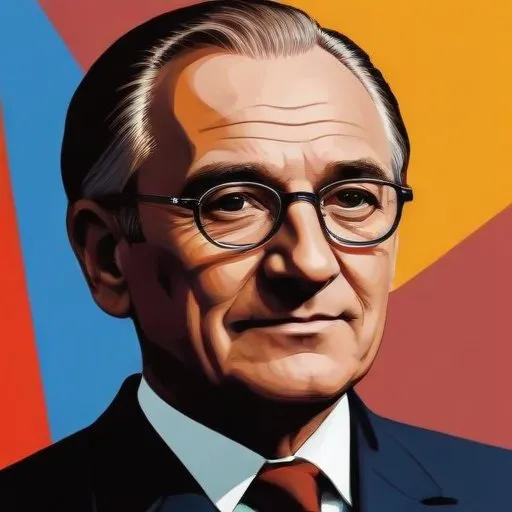
A German educator and politician who advocated for a socialist and nationalist ideology, known for his anti-capitalist and anti-liberal views.
Ernst Niekisch, a German writer and politician, is renowned for his radical ideologies that blurred the lines between socialism and nationalism. As a prominent exponent of National Bolshevism, he advocated for a fusion of Soviet-style communism and German nationalism, earning him both admiration and criticism from various quarters.
Born on May 23, 1889, in Trebnitz, Silesia, Niekisch grew up in Nördlingen, where he was instilled with a strong sense of patriotism and national pride. After completing his teaching seminar, he served a year of voluntary military service with the Bavarian Army, an experience that would shape his views on national identity and military prowess.
In 1917, Niekisch joined the Social Democratic Party (SPD), becoming an active participant in the Bavarian Soviet Republic's brief existence in 1919. For a fleeting moment, he wielded significant power as chairman of the central executive of Bavarian councils, an interim governing body. This experience cemented his reputation as a radical thinker and a champion of revolutionary change.
In the 1920s, Niekisch's disillusionment with the SPD's pacifist stance and acceptance of the Dawes Plan led him to emphasize the importance of nationalism. He believed that a strong, unified Germany was essential for socialism to thrive. This shift in ideology ultimately led to his expulsion from the SPD in 1926.
Undeterred, Niekisch founded his own journal, Widerstand (Resistance), and began to attract like-minded individuals who shared his vision of a nationalist-socialist Germany. This movement, dubbed National Bolshevism, drew inspiration from Soviet Russia's revolutionary fervor and the historical legacy of Prussia. The National Bolsheviks adopted the slogan "Deutschland muss leben, auch wenn wir müssen sterben!" ("Germany must live, even if we must die!"), reflecting their willingness to sacrifice for the sake of national rebirth.
Niekisch's ideas, while influential in certain circles, were met with criticism and suspicion by many. His emphasis on nationalism and military strength raised concerns about his potential sympathies with fascist ideologies. Despite this, his National Bolshevik movement influenced a generation of German thinkers and activists, including some who would later become prominent figures in the Third Reich.
Today, Ernst Niekisch's legacy remains complex and contentious. While his commitment to social justice and revolutionary change is undeniable, his nationalist ideologies and flirtations with authoritarianism have sparked heated debates among scholars and historians.
As we reflect on Niekisch's life and work, we are reminded that the allure of nationalism and the pursuit of revolutionary change can often lead to ambivalent outcomes. His story serves as a cautionary tale about the dangers of ideology and the importance of critically evaluating the actions and motives of those who shape our world.
Born in 1818
A 19th-century philosopher who developed the theory of communism, arguing that capitalism would eventually be replaced by a socialist society. He's known for his critique of capitalism and the concept of class struggle.
Born in 1820
A 19th-century philosopher and economist who co-authored "The Communist Manifesto" with Karl Marx, shaping modern socialist and communist thought. He also wrote extensively on economics, history, and politics.
Born in 1870
Founder of the world's first socialist state, leading the Bolshevik Revolution and establishing the Soviet Union, known for his radical Marxist ideology and authoritarian rule.
Born in 1879
Founded the Red Army and played a crucial role in the Russian Revolution, shaping the course of modern communism. A key figure in 20th-century politics and ideology.
Born in 1885
A German philosopher who explored the concept of utopia and the human desire for a better world, influencing Marxist thought and critical theory.
Born in 1891
An Italian philosopher and politician who developed the concept of cultural hegemony, arguing that power is maintained through cultural and ideological means, rather than just economic or political control.
Born in 1898
A critical theorist who challenged traditional notions of freedom, democracy, and consumerism, arguing that modern society is oppressive and dehumanizing.
