


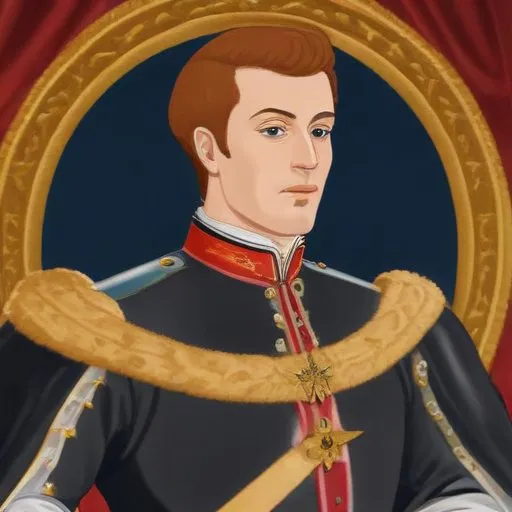
A powerful Italian nobleman who ruled Mantua during the Renaissance, known for his military prowess and cultural patronage, fostering the arts and architecture in his court.
Federico II Gonzaga, Duke of Mantua, was a prominent figure in the Italian Renaissance, known for his patronage of the arts, his military prowess, and his strategic diplomacy that shaped the fate of Mantua and Montferrat. As the ruler of Mantua, he played a crucial role in the turbulent politics of the time, navigating the complex web of alliances and rivalries between the major powers of Europe.
Born on May 17, 1500, Federico was the son of Francesco II Gonzaga, Marquis of Mantua, and Isabella d'Este. His early life was marked by uncertainty and turmoil, as he was held hostage in Rome under Pope Julius II from the age of ten to thirteen. Later, he was a hostage of King Francis I of France from 1515 to 1517, ensuring Gonzaga assistance in Italy.
On April 3, 1519, Federico succeeded his father as Marquis of Mantua, initially under the regency of his mother and uncles Sigismondo and Giovanni Gonzaga. He received the imperial investiture from Emperor Charles V on April 7, 1521. Later that year, Pope Leo X named him Captain General of the Church, commander-in-chief of the Papal Army. Federico fought against the French at Parma in 1521 and at Piacenza in 1522, demonstrating his military prowess.
Federico's marital endeavors were closely tied to his diplomatic ambitions. He signed a marriage contract with Maria Palaeologina, heir to the Marquisate of Montferrat, with the aim of acquiring that land. However, Pope Clement VII voided the contract in 1528, and Federico subsequently signed another contract with Julia of Aragon, Charles V's third cousin. This move earned him the ducal title, and his dynasty became the Dukes of Mantua.
Like his parents, Federico was a great patron of the arts. He commissioned numerous works from prominent artists, including architects, sculptors, and painters. His court was a hub of cultural activity, attracting scholars, poets, and musicians from across Italy.
Federico's legacy is multifaceted. He played a crucial role in shaping the fate of Mantua and Montferrat, securing their independence and prosperity. His patronage of the arts contributed significantly to the cultural heritage of the Italian Renaissance. Furthermore, his diplomatic and military achievements earned him recognition and respect from his contemporaries.
Federico II Gonzaga, Duke of Mantua, was a complex figure who navigated the treacherous landscape of Renaissance politics with skill and diplomacy. His legacy continues to inspire and fascinate us to this day, a testament to his enduring impact on the world of art, politics, and culture.
Born in 1474
Renowned for epic poems, particularly "Orlando Furioso", which masterfully blended chivalric romance and Renaissance humanism, influencing literature for centuries.
Born in 1470
A 16th-century Renaissance humanist who wrote influential poetry and treatises on literature, and was a key figure in developing the modern Italian language.
