


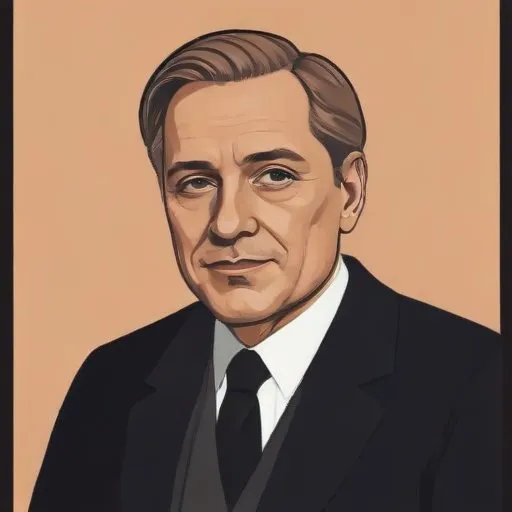
A 19th-century polymath who wrote influential historical novels and treatises on Germanic law and culture, leaving a lasting impact on the country's literary and academic landscape.
Felix Dahn, a German law professor, nationalist author, poet, and historian, is renowned for his influential works on the European Migration Period, also known as the Völkerwanderung, and his nationalist historical novels that shaped the German intellect prior to the Hitlerian era.
Dahn was born on February 9, 1834, in Hamburg, Germany, to Friedrich and Constanze Dahn, notable actors at the city's theater. His family had both German and French roots. Dahn began his studies in law and philosophy in Munich, where he had moved with his parents in 1834, and graduated as Doctor of Laws in Berlin.
After completing his habilitation treatise, Dahn became a lecturer of German Law in Munich in 1857. He later became a senior lecturer/associate professor in Würzburg in 1863 and received a professorship in Königsberg in 1872. In 1888, he relocated to the University of Breslau as a full professor and was elected rector of the university in 1895.
Dahn's writings were instrumental in shaping the conception of the European Migration Period in German historiography. His multivolume Prehistory of the Germanic and Roman Peoples, a chronology of the Migration Period, first appeared in print in 1883 and was so definitive that abbreviated versions were reprinted until the late 1970s.
From the 1860s, Dahn regularly wrote for Die Gartenlaube, Germany's most popular family magazine. His nationalist historical novels were widely received and, according to Housden (1997), were influential in the formation of the völkisch ideology that formed the German pre-Hitlerian intellectual landscape.
Dahn was married to the artist Sophie Fries (1835-1898), with whom he had a son. He tutored Baroness Therese von Droste-Hülshoff, a relative of the poet Annette von Droste-Hülshoff, in poetry from 1867 and entered an illicit love affair with her, which he gave a literary treatment in his Sind Götter (1874). He divorced his wife and married Therese in 1873, against opposition from both families.
Felix Dahn's works had a profound impact on the German intellectual landscape, shaping the country's historiography and nationalist ideology. His legacy extends beyond the academic realm, influencing popular culture and the formation of the German identity.
Felix Dahn's remarkable life and works continue to fascinate scholars and readers alike, offering a glimpse into the intellectual and cultural landscape of Germany during a pivotal period in its history.
Born in 1817
A renowned historian and scholar who wrote extensively on ancient Rome, earning a Nobel Prize in Literature for his monumental work "The History of Rome".
Born in 1814
A pioneering archaeologist and historian who uncovered the rich history of ancient Greece, shedding light on its art, architecture, and culture. His works remain a cornerstone of classical studies.
Born in 1820
A 19th-century philosopher and economist who co-authored "The Communist Manifesto" with Karl Marx, shaping modern socialist and communist thought. He also wrote extensively on economics, history, and politics.
Born in 1818
A 19th-century philosopher who developed the theory of communism, arguing that capitalism would eventually be replaced by a socialist society. He's known for his critique of capitalism and the concept of class struggle.
Born in 1815
Unified Germany's founder, a master strategist who forged a nation through diplomacy and war, leaving a lasting legacy in European politics.
Born in 1849
A German naval strategist who transformed the German Navy into a major world power, and is credited with building the German U-boat fleet that threatened Britain's naval supremacy during World War I.
