


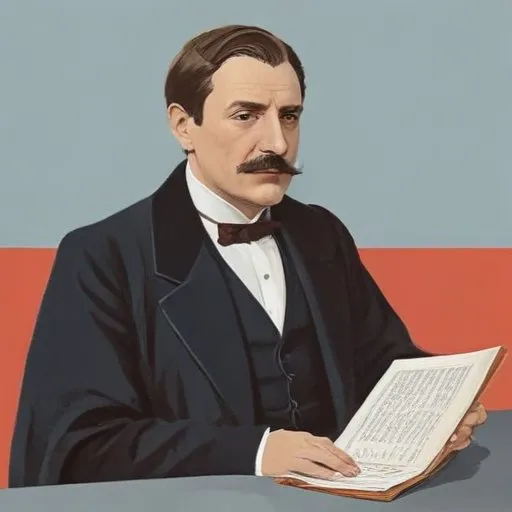
A 19th-century German philosopher and jurist who developed the concept of the "iron law of oligarchy," which states that power tends to concentrate in the hands of a few individuals. He also advocated for workers' rights and social reform.
Ferdinand Lassalle is best remembered as the pioneer of the social democratic movement in Germany, successfully organizing a party of socialist action in a span of just two years, an achievement that would take decades to accomplish, as aptly put by Rosa Luxemburg.
Lassalle's legacy is monumental, marked by his introduction of the terms "nightwatchman state" and "iron law of wages", which have had a profound impact on the development of socialist thought.
Born Ferdinand Johann Gottlieb Lassal on 11 April 1825 in Breslau, Silesia (now Wrocław, Poland), Lassalle was the son of a Jewish silk merchant, Heyman Lassal. Initially, his father intended for him to pursue a business career, enrolling him in the commercial school at Leipzig. However, Lassalle's interests lay elsewhere, and he soon transferred to the University of Breslau and later to the University of Berlin, where he studied philology and philosophy.
During his university years, Lassalle became deeply influenced by the philosophical system of Georg Hegel, which would shape his intellectual trajectory. He passed his university examinations with distinction in 1845 and later traveled to Paris to write a book on Heraclitus.
Lassalle's encounter with the poet Heinrich Heine in Paris had a profound impact on his life. Heine, impressed by Lassalle's passion and intellect, wrote in 1846: "I have found in no one so much passion and clearness of intellect united in action. You have good right to be audacious – we others only usurp this divine right, this heavenly privilege."
Back in Berlin, Lassalle became involved in the dispute between Countess Sophie von Hatzfeldt and her husband, volunteering himself to her cause. This marked the beginning of his journey as a social activist, challenging the count to a duel and later dedicating himself to the countess's cause.
Lassalle's philosophical contributions are characterized by his emphasis on the role of the state in promoting social welfare and his critique of capitalism. He argued that the state should play a more active role in regulating the economy and protecting the rights of workers.
His concept of the "nightwatchman state" referred to a minimalist state that limited its activities to protecting property and maintaining order, while his "iron law of wages" posited that wages would inevitably decrease to the minimum level necessary for workers to survive.
Lassalle's legacy has had a lasting impact on modern society. His ideas influenced the development of social democracy in Germany and beyond, shaping the country's social and political landscape.
His emphasis on the importance of worker rights, social welfare, and state intervention in the economy continue to resonate with contemporary debates on social justice and economic inequality.
Ferdinand Lassalle's life and work have left an indelible mark on the history of social democracy. His ideas continue to inspire and shape the lives of millions, making him one of the most important figures of the 19th century.
As Rosa Luxemburg aptly put it, "What Lassalle managed to wrestle from history in two years of flaming agitation needed many decades to come about." His legacy serves as a testament to the power of human agency and the importance of fighting for social justice.
Born in 1818
A 19th-century philosopher who developed the theory of communism, arguing that capitalism would eventually be replaced by a socialist society. He's known for his critique of capitalism and the concept of class struggle.
Born in 1820
A 19th-century philosopher and economist who co-authored "The Communist Manifesto" with Karl Marx, shaping modern socialist and communist thought. He also wrote extensively on economics, history, and politics.
Born in 1810
A 19th-century German poet and translator who played a significant role in popularizing American literature in Germany, particularly the works of Henry Wadsworth Longfellow.
Born in 1805
A leading figure in the Italian unification movement, he advocated for a unified Italian republic and inspired similar movements across Europe. His ideas influenced modern nationalism and democracy.
Born in 1805
A 19th-century French historian and philosopher who traveled to America to study its democracy, producing a seminal work on the country's political and social structures. He's known for his insightful commentary on the American experiment and its implications for modern democracy.
Born in 1809
A 19th-century French economist and politician who advocated for anarchism, socialism, and mutualism, and is known for coining the phrase "Property is Theft."
Born in 1814
A Russian philosopher and theorist who advocated for anarchism and the abolition of the state, and is known for his influence on the development of anarchist thought. His ideas emphasized individual freedom and the rejection of authority.
Born in 1770
A German philosopher and academic who developed a comprehensive and systematic philosophy that emphasized the unity of all things and the dialectical process of thesis, antithesis, and synthesis. His ideas have had a profound impact on modern thought, influencing fields such as philosophy, politics, and art.
