


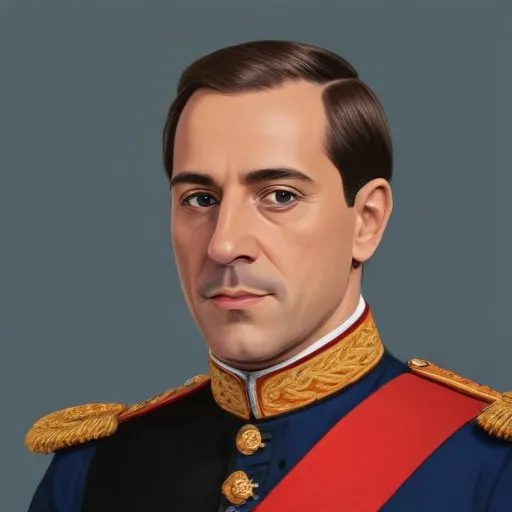
King of Spain who ruled with an iron fist, suppressing liberal reforms and reinstating absolute monarchy, sparking multiple uprisings and wars.
Ferdinand VII, known as the "Desired One," was the King of Spain from 1808 to 1833, except for a brief period in 1808 and 1820 to 1823. He is infamous for his absolutist reign, marked by fierce repression, censorship, and a strong centralized government.
Ferdinand VII was born on October 14, 1784, to King Charles IV and Queen Maria Luisa of Parma. He was the eldest son and heir apparent, groomed from a young age to take the throne. In 1808, following the abdication of his father, Ferdinand VII ascended to the throne, but his reign was short-lived. Napoleon Bonaparte, who had occupied Spain, forced him to abdicate and installed his own brother, Joseph Bonaparte, as the new King of Spain.
During the Peninsular War, Ferdinand VII remained in captivity, while Spanish forces fought against the French occupation. In 1813, the Anglo-Spanish alliance defeated the French, and Ferdinand VII was restored to the throne. However, his reinstatement was conditional upon his acceptance of the Spanish Constitution of 1812, which limited his power and established a constitutional monarchy.
Ferdinand VII rejected the constitution and reinstated absolute monarchy, sparking widespread discontent. He abolished the Constitution of 1812, persecuted liberals, and reinstated the Inquisition. His regime was marked by censorship, arbitrary arrests, and brutal suppression of dissent. The king's zeal for absolute power led to the execution of many prominent liberals and opposition figures.
Ferdinand VII's reign had significant implications for Spanish history. He re-established the Spanish Empire, albeit briefly, and attempted to reassert Spanish dominance in the Americas. His absolutist policies, however, led to increased regionalism, ultimately contributing to the fragmentation of Spain.
Ferdinand VII married four times, with his marriages being marked by scandal, intrigue, and tragedy. His personal life was tumultuous, with rumors of extramarital affairs and alleged involvement in the murder of his wife, Maria Isabel of Portugal.
Ferdinand VII's legacy is complex and controversial. While he is often remembered as a reactionary and authoritarian ruler, he also played a crucial role in re-establishing Spanish sovereignty and attempting to restore the country's colonial empire. His absolutist policies, however, ultimately contributed to the decline of the Spanish monarchy and the rise of liberalism and republicanism.
"I am the king, and I do not need to explain myself to anyone." - Ferdinand VII, demonstrating his commitment to absolute authority.
Ferdinand VII's reign occurred during a period of significant political and social upheaval in Europe. The French Revolution, the Napoleonic Wars, and the subsequent Congress of Vienna reshaped the continent. In this context, Ferdinand VII's absolutist policies were seen as an attempt to counter the tide of liberal democracy and maintain the status quo of monarchical power.
Ironically, his reactionary stance ultimately contributed to the decline of the Spanish monarchy and paved the way for the rise of liberal and republican movements in Spain.
Ferdinand VII's contemporaries, such as Napoleon Bonaparte and King Louis XVIII of France, were fellow monarchs who navigated the treacherous landscape of post-Napoleonic Europe. While all three rulers sought to reassert their authority, Ferdinand VII's absolutist stance set him apart from his contemporaries, who acknowledged the need for constitutional limits on monarchical power.
In conclusion, Ferdinand VII's reign was marked by controversy, repression, and a commitment to absolute authority. While his policies had significant implications for Spanish history, his legacy is complex and multifaceted, reflecting both the virtues and vices of a bygone era.
Born in 1661
The last ruler of the Spanish Empire's Habsburg dynasty, known for their physical and mental disabilities, which led to a decline in the empire's power and eventual downfall. They are infamous for their inbreeding and the subsequent weaknesses it brought to the throne.
Born in 1768
The elder brother of Napoleon, he was a king of Naples and Sicily, and later of Spain, known for his brief but significant reigns in these countries.
Born in 1746
A visionary artist who pioneered Romanticism, capturing the human experience through bold, emotionally charged paintings and sculptures that continue to inspire and unsettle.
Born in 1767
A Spanish field marshal and politician who dominated Spanish politics during the late 18th and early 19th centuries, known for his corrupt and authoritarian rule. He was a favorite of King Charles IV and Queen Maria Luisa, and his policies led to widespread discontent and eventually, the Spanish War of Independence.
Born in 1830
Queen of Spain from 1833 to 1868, known for her tumultuous reign marked by political instability, corruption, and social unrest. She was eventually exiled to France after a revolution.
