


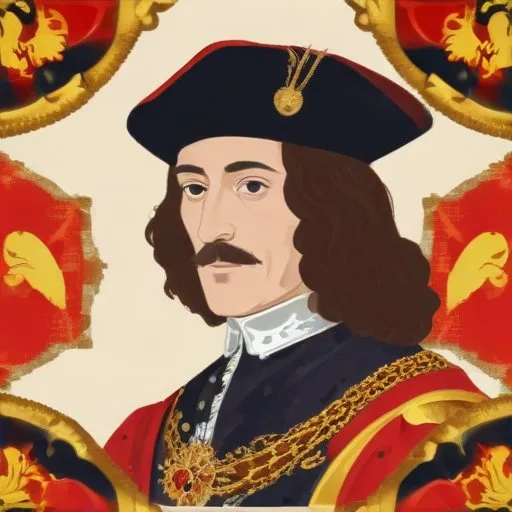
The last ruler of the Spanish Empire's Habsburg dynasty, known for their physical and mental disabilities, which led to a decline in the empire's power and eventual downfall. They are infamous for their inbreeding and the subsequent weaknesses it brought to the throne.
Charles II of Spain, who reigned from 1665 to 1700, is remembered for being the last monarch from the House of Habsburg, which had ruled Spain since 1516. His reign was marked by physical disabilities, childlessness, and the War of the Spanish Succession that followed his death.
Charles was born on November 6, 1661, to Philip IV of Spain and Mariana of Austria, who were uncle and niece. This consanguineous marriage was a common practice among European nobility to retain property, but the Spanish and Austrian Habsburgs took it to an extreme extent.
As a result, Charles suffered from numerous physical disabilities, including epilepsy, which led to extended periods of ill health throughout his life. His physical condition was a concern for European politicians, who were eager to know who would inherit his throne.
The two main candidates to succeed Charles were Archduke Charles of Austria and Philip of Anjou, grandson of Maria Theresa of Spain and Louis XIV of France. Acquisition of the Spanish Empire by either of these candidates would have altered the European balance of power in favor of France or Austria.
In November 1700, Charles named Philip of Anjou as his heir, but the failure to resolve the succession crisis through diplomacy led to the War of the Spanish Succession in 1701. The war would last for 13 years, involve several European powers, and eventually lead to the Treaty of Utrecht, which recognized Philip V of Spain as the king.
Charles married twice, first to Marie Louise d'Orléans in 1679, and then to Maria Anna of Neuburg in 1680. Neither marriage produced children, leaving the question of succession unanswered during his lifetime.
Charles II's legacy is marked by his physical disabilities, childlessness, and the War of the Spanish Succession. However, his reign also saw the establishment of the Council of Commerce and the Board of Trade, which promoted Spanish trade and commerce.
Despite his physical limitations, Charles was known for his strong will and determination. He was also a patron of the arts, and his court attracted many artists and composers, including the famous Spanish composer, José Cascante.
Charles II of Spain's legacy may be marked by controversy and instability, but it is also a testament to his determination and strength in the face of adversity.
Born in 1578
Ruling Spain from 1598 to 1621, he oversaw the country's peak of power and cultural flourishing, while also facing challenges from the Thirty Years' War and the Inquisition.
Born in 1710
The monarch who ruled France from 1715 to 1774, known as the "Sun King's" great-grandson, and remembered for his extravagance, absolutism, and the decline of the French monarchy.
Born in 1747
The last Habsburg ruler to hold the title of Holy Roman Emperor, he oversaw the dissolution of the empire and played a key role in European politics during the French Revolution.
Born in 1630
The last monarch of the House of Stuart, restored to the throne after a republican Commonwealth, known for his lavish spending, mistresses, and the Great Fire of London. He ruled with a mix of absolutism and indulgence, shaping England's Restoration era.
Born in 1633
The last Catholic monarch of England, Scotland, and Ireland, who attempted to restore Catholicism and absolute monarchy, sparking the Glorious Revolution. He's infamous for his authoritarian rule and religious intolerance.
Born in 1650
The Prince of Orange, King of England, Scotland, and Ireland, led the Glorious Revolution, overthrowing the Catholic King James II, and ruled with his wife Mary II, establishing a Protestant monarchy. He's also known for his military victories in Ireland and Europe.
