


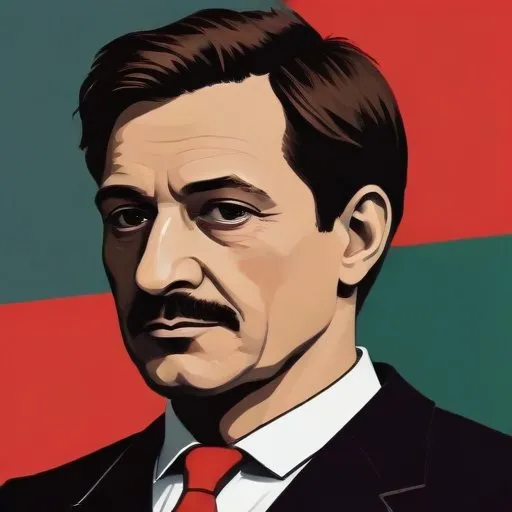
A Hungarian-French journalist and political scientist who wrote extensively on Eastern European politics and was a prominent voice on Cold War issues. He's known for his insightful analysis of Soviet bloc politics and international relations.
Ferenc Fejt, also known as Franois Fejt, was a Hungarian-born French journalist and political scientist renowned for his extensive knowledge and expertise on Eastern Europe. Throughout his illustrious career, he made significant contributions to the field, earning him recognition and respect from his peers and contemporaries.
Fejt was born on August 31, 1909, in Nagykanizsa, Hungary, to a wealthy Jewish family of booksellers and publishers. Raised as a Roman Catholic, he went on to study literature at Pcs and Budapest universities, where he was exposed to a diverse group of Slavic, German, and Italian students.
In 1932, Fejt's involvement in a Marxist study group led to his imprisonment for a year. This experience did not deter him from his political convictions, and in 1934, he joined the Social Democratic Party, contributing to the Npszava daily and Szocializmus journal. His anti-fascist and anti-Stalinist stance led him to co-found the literary journal Szp Sz with poet Attila Jzsef and publicist Pl Ignotus in 1935.
In 1938, Fejt fled Hungary for France, where he continued to write and publish works critical of the pro-German stance of the Hungarian government. During World War II, he actively participated in the French Resistance. After the war, he headed the press department of the Hungarian embassy in Paris, but soon resigned in protest against the condemnation of his friend Lszl Rajk, cutting all ties with Hungary.
In 1945, Fejt attended the Congrs des intellectuels pour la libert, alongside prominent figures such as Raymond Aron, Franois Bondy, and David Rousset. His 1952 book, A History of the Peoples Democracies, translated into seventeen languages, solidified his reputation as a leading expert on Eastern Europe. This work earned him suspicion from certain intellectual circles close to the French Communist Party, but Fejt remained unwavering in his convictions.
Fejt's journalistic career spanned over three decades, during which he worked at the Agence France-Presse, commenting on Eastern European affairs. His commitment to truth and accuracy earned him recognition and respect from his peers. Through his work, Fejt left an indelible mark on the field of journalism and political science, inspiring generations to come.
In 1989, Fejt returned to Hungary for Imre Nagy's national funeral, marking a rare visit to his native country. Fejt passed away on June 2, 2008, leaving behind a rich legacy of intellectual pursuits, unwavering convictions, and a commitment to truth and accuracy.
Ferenc Fejt's life serves as a testament to the power of intellectual pursuit, unwavering convictions, and a commitment to truth and accuracy. His legacy continues to inspire and educate generations, cementing his place as one of the most important figures in the field of journalism and political science.
Born in 1905
A prominent public intellectual who wrote extensively on politics, history, and philosophy, offering insightful critiques of totalitarianism and communism. Known for his advocacy of liberal democracy and nuanced understanding of modern society.
Born in 1905
Existentialist philosopher and playwright who argued that humans have complete freedom to choose their actions and create their own meaning in life, influencing modern thought on morality and individual responsibility.
Born in 1908
A pioneering feminist philosopher who wrote extensively on ethics, politics, and gender, famously arguing that "one is not born, but rather becomes, a woman."
Born in 1908
A French philosopher and academic who developed the concept of phenomenology, exploring the relationship between the self and the world, and is known for his work on perception, consciousness, and embodiment.
Born in 1913
A French novelist, philosopher, and journalist who wrote influential works like "The Stranger" and "The Plague", exploring absurdism and the human condition.
Born in 1906
A 20th-century philosopher and theorist who explored the nature of power, politics, and humanity, particularly in the context of totalitarianism and the Holocaust.
Born in 1903
A critical theorist who critiqued modern society, culture, and capitalism, arguing that they perpetuate inequality and stifle individual freedom. His work influenced many fields, from sociology to musicology.
Born in 1898
A critical theorist who challenged traditional notions of freedom, democracy, and consumerism, arguing that modern society is oppressive and dehumanizing.
