


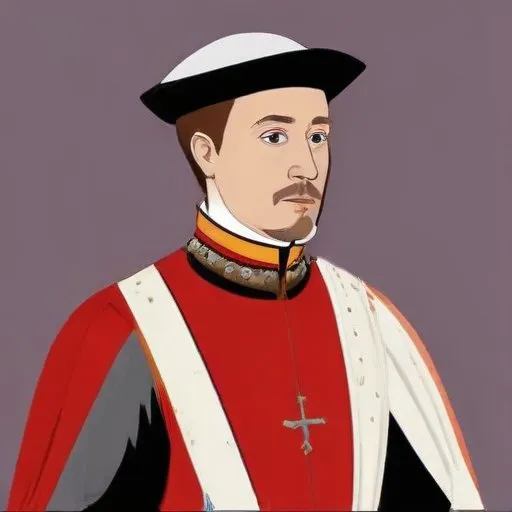
A French nobleman who ruled over several territories, including Nevers and Rethel, and played a significant role in the French Wars of Religion. He was a prominent military leader and diplomat.
Francis I, Duke of Nevers, is renowned for his dual mastery of the culinary arts and the intricate diplomacy of 16th-century Europe. As a member of the illustrious House of Cleves, Francis I left an indelible mark on the gastronomic and political landscapes of his time.
Francis I's passion for fine cuisine was legendary. His court at Nevers became a epicurean hub, attracting some of the finest chefs and gourmands of the era. The duke's love for rich, bold flavors and exotic spices inspired a new wave of culinary innovation, which would later influence the development of French haute cuisine.
One of Francis I's most enduring legacies is the creation of the signature Neversian dish, Poulet au Pistou, a sublime fusion of chicken, fresh herbs, and aromatic spices. This iconic recipe, passed down through generations, remains a staple of French country cooking to this day.
Beyond the realm of gastronomy, Francis I was a skilled diplomat and strategist. As a trusted advisor to King Francis I of France, he played a crucial role in negotiating the Treaty of Cambrai (1529), a pivotal agreement that temporarily ended the Italian Wars and established a fragile peace in Europe.
Francis I's diplomatic prowess was further demonstrated during the Papal Conclave of 1549-1550, where he successfully campaigned for the election of Pope Julius III, solidifying French influence within the Vatican.
"A well-laid table is the foundation of a harmonious state."
"The art of diplomacy is akin to the art of cooking – both require patience, precision, and a dash of creativity."
Francis I, Duke of Nevers, lived during a time of great upheaval and transformation in Europe. His unique blend of gastronomic passion and diplomatic acumen helped to shape the course of history, leaving a lasting impact on French cuisine, politics, and culture.
Today, Francis I's legacy extends beyond the boundaries of Nevers, influencing the culinary and diplomatic traditions of France and beyond. His story serves as a testament to the power of creativity, innovation, and strategic thinking in shaping the course of human history.
Born in 1519
King of France from 1547 to 1559, known for his cultural and artistic patronage, and his role in the Italian Wars.
Born in 1785
The last king of the French monarchy before the French Revolution, known for his tragic and mysterious life, including his imprisonment and disputed death.
Born in 1585
A powerful and cunning statesman who dominated French politics during the 17th century, known for his ruthless suppression of dissent and centralization of power. He was a master strategist and diplomat who shaped the course of European history.
Born in 1601
The queen who ruled France alongside her son Louis XIV, known as the Sun King, and played a significant role in shaping the country's politics and culture during the 17th century. She was a skilled diplomat and strategist who helped to establish France as a dominant European power.
Born in 1575
The Queen of France who commissioned the Luxembourg Palace and was the subject of Peter Paul Rubens' famous cycle of paintings, known for her extravagant lifestyle and political influence.
