


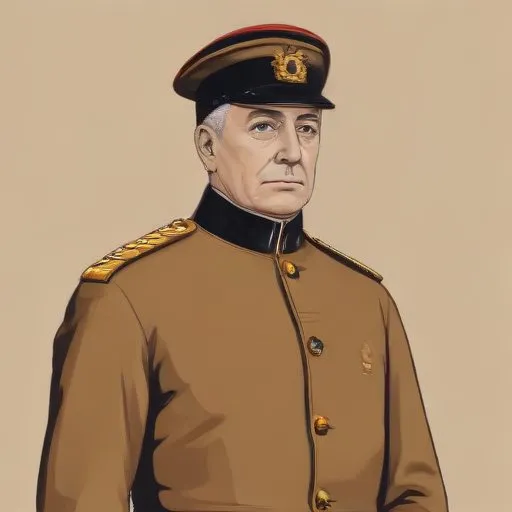
A British Army general and colonial administrator who played a key role in the establishment of the Province of Virginia and served as its governor from 1690 to 1692. He's also known for his military campaigns against the French in North America.
Francis Nicholson, a British Army general and colonial official, is best known for his extraordinary administrative prowess, which earned him governorship positions in various colonies, including South Carolina, Nova Scotia, Virginia, Maryland, and the Dominion of New England. Throughout his illustrious career, Nicholson demonstrated unwavering dedication to the development of the colonies, making significant contributions to education, politics, and warfare.
Born on November 12, 1655, Nicholson's early life was marked by a strong affinity for the military. He served in Africa and Europe before being sent to North America, where he supported Governor Sir Edmund Andros in the Dominion of New England. Nicholson's bravery and strategic thinking soon earned him the appointment as lieutenant governor of the Dominion in 1688.
Following the Glorious Revolution and the overthrow of King James II, Nicholson found himself amidst civil unrest in Leisler's Rebellion in New York Town. After a brief period in England, he returned to the colonies, serving as lieutenant governor or governor of Virginia and Maryland. Nicholson's commitment to education led him to support the founding of the College of William and Mary in Williamsburg, Virginia, an institution that would go on to shape the minds of many future leaders.
In 1709, Nicholson became involved in colonial military actions during Queen Anne's War (1702-1713), part of the larger War of the Spanish Succession in Europe. He led an expedition against the French in New France (modern-day Canada), which, although unsuccessful, showcased his military acumen. Nicholson later led a successful expedition that captured Port Royal, Acadia, on October 2, 1710, demonstrating his ability to adapt and persevere in the face of adversity.
After his military conquests, Nicholson served as governor of Nova Scotia and Placentia, and later became the first royal governor of the colonial Province of South Carolina following a rebellion against its proprietors. His governorship was marked by wisdom, fairness, and a deep understanding of the complexities of colonial politics.
Francis Nicholson rose to the rank of Lieutenant General and remained a bachelor throughout his life. He passed away on March 5, 1728, in London, England, leaving behind a legacy of public service, military prowess, and unwavering commitment to the development of the colonies.
Francis Nicholson's remarkable life serves as a testament to his unwavering dedication to public service, education, and the development of the colonies. His legacy continues to inspire generations, offering a glimpse into the complexities and triumphs of colonial America.
Born in 1727
Led British forces to victory in the Battle of Quebec in 1759, a pivotal moment in the French and Indian War, and is considered a hero in British military history.
Born in 1725
A British military leader who conquered Bengal, India, and later became a politician, known for his significant role in establishing British rule in India.
Born in 1837
Compiler of the Oxford English Dictionary, revolutionizing the field of lexicography with his comprehensive and authoritative work. His dictionary remains an indispensable reference for scholars and language enthusiasts alike.
Born in 1723
Led British forces during the American Revolutionary War, ultimately surrendering at Saratoga, a turning point in the war. He was also a playwright and politician.
Born in 1732
The first President of the United States, a military hero who led the country to independence, and set the standard for the office of the presidency. He's known for his honesty, integrity, and leadership skills.
