


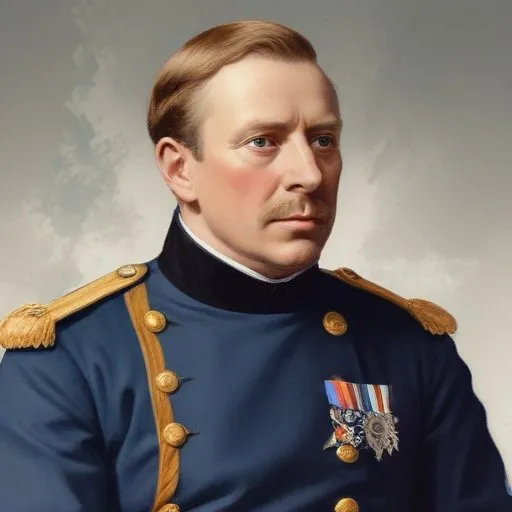
Led expeditions to explore the Euphrates River and proposed a canal connecting the Mediterranean Sea to the Red Sea, precursor to the Suez Canal. He was a British general and explorer who served in India and the Middle East.
Francis Rawdon Chesney, a British general and explorer, is best known for his pioneering efforts in conceptualizing the Suez Canal, a marvel of modern engineering that revolutionized global trade and commerce. His visionary idea, submitted in 1830, laid the foundation for Ferdinand de Lesseps' successful construction of the canal in 1869, earning Chesney the title "Father of the Suez Canal".
Born on March 16, 1789, in Annalong, County Down, Ireland, Chesney was the son of Captain Alexander Chesney, an Irishman of Scottish descent. His father's association with Lord Rawdon (later Marquess of Hastings) during the American War of Independence led to Chesney's cadetship at the Royal Military Academy, Woolwich. He was gazetted to the Royal Artillery in 1805 and rose through the ranks, becoming lieutenant-general and colonel-commandant of the 14th brigade Royal Artillery in 1864, and finally, a general in 1868.
In 1829, during his military duties, Chesney was sent to Constantinople, where he began to explore the feasibility of a Suez Canal. His subsequent tour of inspection in Egypt and Syria further solidified his idea, which he submitted in a report in 1830. Chesney's vision was met with initial skepticism, but he persisted, convinced of the canal's potential to revolutionize trade and commerce.
Before the Suez Canal, Chesney was interested in exploring alternative routes to India. In 1832, he submitted a report suggesting that the Euphrates River could be traversable for suitable steamers. He spent the next three years persuading the British government to undertake a trial experiment, which finally began in 1835. The expedition involved sending two iron-hulled steamboats, the Euphrates and the Tigris, to survey the long stretch of the river Euphrates from the Anatolian mountains to the Persian Gulf.
Chesney's contribution to the concept of the Suez Canal earned him recognition from Ferdinand de Lesseps himself, who greeted him as the "Father of the Canal" in Paris. Though Chesney's military career was marked by several promotions and achievements, it is his vision and perseverance in the face of skepticism that have left a lasting impact on modern history.
"The Suez Canal will be a work of great magnitude, but it is a work of necessity, and it will be accomplished."
Francis Rawdon Chesney's legacy continues to inspire generations, a testament to the power of vision, perseverance, and innovative thinking.
Born in 1821
A 19th-century explorer who ventured into uncharted territories, mapping Africa's Nile River and uncovering hidden cities, earning a reputation as a daring adventurer and scholar.
Born in 1813
A Scottish missionary and explorer who traversed Africa, mapping its rivers and discovering Victoria Falls, while fighting against the slave trade. He embodied courage, compassion, and curiosity.
Born in 1827
A British soldier and explorer who led expeditions to Africa, discovering the source of the Nile River in 1858. He was the first European to set eyes on Lake Victoria.
Born in 1820
Pioneering nurse and statistician who revolutionized healthcare by introducing sanitation practices and data-driven decision making, becoming the founder of modern nursing.
Born in 1833
A British army officer who led military campaigns in Africa and China, and later became the governor of Sudan, known for his bravery and heroism during the Siege of Khartoum.
Born in 1871
Prolific writer of historical novels and adventure stories, also a talented landscape painter.
