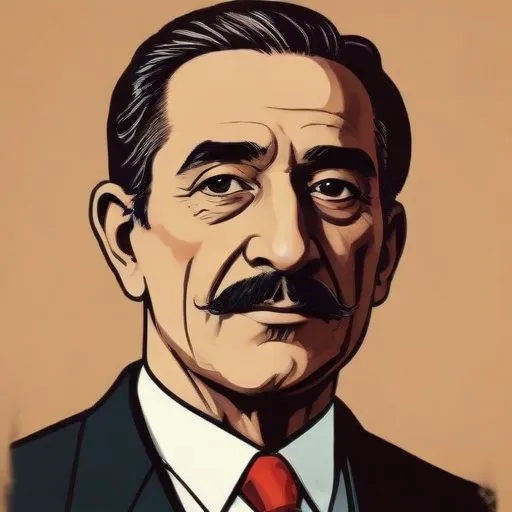
Francisco S. Carvajal: The Unlikely President of Mexico
A Brief but Significant Tenure
Francisco Sebastián Carvajal y Gual, a Mexican lawyer and politician, served as the President of Mexico for a brief period in 1914, during the tumultuous Mexican Revolution. His presidency was a result of a series of events that led to the resignation of
Victoriano Huerta, and Carvajal's subsequent ascension to the highest office in the land.
A Life of Public Service
Born on December 9, 1870, in Campeche, Mexico, Carvajal studied jurisprudence and went on to occupy important positions in the administration of President
Porfirio Díaz. In 1911, Díaz named him as his representative at the peace conference with constitutionalist rebel
Francisco I. Madero. This marked the beginning of Carvajal's involvement in the complex web of Mexican politics.
Rise to Power
In 1913, after Victoriano Huerta seized power from Madero, Huerta named Carvajal as the president of the Supreme Court. Later, on July 10, 1914, Huerta appointed him as foreign minister. When Huerta resigned on July 15, Carvajal was next in line to the presidency.
A President's Legacy
During his month-long presidential term, Carvajal oversaw the transfer of power to
Venustiano Carranza and his Constitutionalist Army under the terms of the Teoloyucan Treaties. Although his presidency was short-lived, Carvajal played a crucial role in maintaining stability during a time of great turmoil.
The Later Years
After leaving office on August 13, 1914, Carvajal went into exile in the United States, where he met and married Louise Martin in New Orleans. The couple had one child, Francisco Carvajal, born on October 19, 1918. In 1922, Carvajal returned to Mexico City to resume his legal profession. He passed away on September 20, 1932.
Legacy and Impact
Although Carvajal's presidency was brief, his impact on Mexican history is undeniable. He played a crucial role in maintaining stability during a time of great upheaval and paved the way for the eventual rise of Venustiano Carranza to power. Carvajal's legacy serves as a testament to the complex and often tumultuous nature of Mexican politics during the early 20th century.
- Personal Milestones and Key Life Events:
- Born on December 9, 1870, in Campeche, Mexico
- Studied jurisprudence
- Ocupied important positions in the administration of President Porfirio Díaz
- Served as foreign minister under Victoriano Huerta
- Became President of Mexico on July 15, 1914
- Left office on August 13, 1914
- Went into exile in the United States
- Married Louise Martin in New Orleans
- Had one child, Francisco Carvajal, born on October 19, 1918
- Returned to Mexico City in 1922 to resume his legal profession
- Died on September 20, 1932
Historical Context and Legacy
Carvajal's life and legacy are deeply intertwined with the complex and tumultuous history of Mexico during the early 20th century. His presidency, although brief, serves as a testament to the country's struggle for stability and democracy. Today, Carvajal is remembered as a significant figure in Mexican history, a man who played a crucial role in shaping the country's future.
FAQ
What is Francisco Carvajals significance in Mexican history?
Francisco Carvajal, a prominent Mexican lawyer and politician, played a significant role in Mexican history as the president of Mexico in 1914, during a tumultuous period of political upheaval and revolution.
How did Francisco Carvajals political career begin?
Francisco Carvajals political career began as a member of the Mexican Congress, where he advocated for liberal reforms and later served as a cabinet member in the government of President Victoriano Huerta.
What is Francisco Carvajals connection to the Mexican Revolution?
Francisco Carvajals connection to the Mexican Revolution is complex, as he initially supported the regime of President Victoriano Huerta, but later broke with him and joined the constitutionalist forces led by Venustiano Carranza.
What is Francisco Carvajals legacy in Mexican politics?
Francisco Carvajals legacy in Mexican politics is marked by his efforts to promote constitutional government and democracy, despite the challenges posed by the Mexican Revolution and its aftermath.
What is Francisco Carvajals significance in the history of Latin American politics?
Francisco Carvajals significance in the history of Latin American politics lies in his contribution to the development of democratic institutions and the rule of law in Mexico, serving as a model for other Latin American countries.