


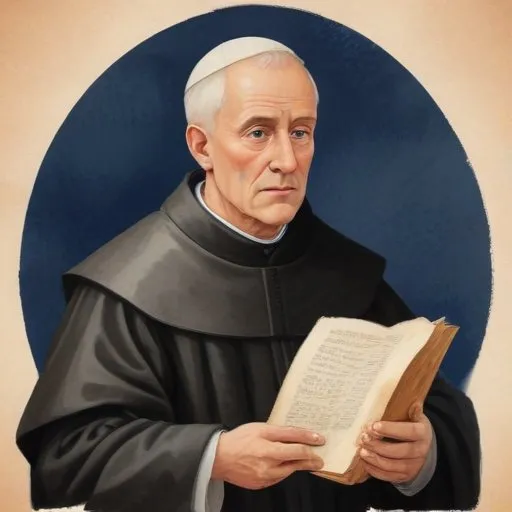
A Dutch theologian who played a key role in the Counter-Reformation, shaping Catholic doctrine and influencing the Church's response to Protestantism. He's known for his writings on ecclesiastical authority and the Eucharist.
Renowned for his pivotal role in the Catholic Reformation, Franciscus Sonnius was a theologian, bishop, and professor who left an indelible mark on the ecclesiastical landscape of 16th-century Europe. As the first bishop of 's-Hertogenbosch and later Antwerp, Sonnius played a crucial role in shaping the Catholic Church's response to the Protestant Reformation.
Born on August 12, 1506, in Son, Brabant, Sonnius hailed from a noble family, with his family name being Van de Velde. He adopted the name Sonnius, derived from his native place, later in life. His family's coat of arms features three golden millirons, a symbol that would later be emblazoned on the chair of the first bishop in the Antwerp cathedral.
Sonnius received his education in 's-Hertogenbosch and Leuven, where he studied medicine before turning his attention to theology. He earned his licentiate in 1536 and doctorate in theology in 1539, laying the foundation for a distinguished career in the Church.
Following a brief stint as a parish priest in Meerbeek and Leuven, Sonnius became a professor of theology at Leuven University in 1544. This marked the beginning of his ascent to prominence, as he soon found himself attending the Council of Trent in 1546, 1547, and 1551. His involvement in the Council of Trent further solidified his reputation as a theologian and mediator.
In 1557, Sonnius participated in the Colloquy of Worms, where he played a key role in facilitating dialogue between Catholics and Protestants. His diplomatic prowess caught the attention of Philip II of Spain, who dispatched him to Rome to negotiate with Pope Paul IV on ecclesiastical matters in the Netherlands.
In recognition of his achievements, Sonnius was appointed bishop of 's-Hertogenbosch in 1566, although he was not consecrated until 1568 by Cardinal Granvelle. This marked the beginning of a new chapter in his career, as he went on to become the first bishop of Antwerp in 1569.
As bishop of Antwerp, Sonnius established an ecclesiastical court, visited parishes throughout his diocese, and proclaimed the decrees of the Council of Trent. He also convened two diocesan synods, setting a precedent for future bishops.
Franciscus Sonnius's contributions to the Catholic Reformation have had a lasting impact on the Church. His commitment to dialogue, diplomacy, and ecclesiastical reform helped shape the Church's response to the Protestant Reformation. As a theologian, bishop, and professor, Sonnius left behind a rich legacy that continues to inspire and inform the Catholic Church to this day.
Through his tireless efforts, Franciscus Sonnius ensured that the Catholic Church remained a vibrant and dynamic force in the face of Protestantism. His legacy continues to inspire generations of Catholics, theologians, and scholars, solidifying his place as a pivotal figure in the Catholic Reformation.
Born in 1542
A 16th-century theologian and doctor of the Church, known for his writings on spirituality and his role in shaping Catholic doctrine. He was a key figure in the Counter-Reformation, defending Catholicism against Protestantism.
Born in 1548
A 16th-century Spanish priest, philosopher, and theologian who developed influential concepts in metaphysics, ethics, and law, shaping modern Western philosophy. His works heavily influenced Enlightenment thinkers and the development of international law.
Born in 1469
A 16th-century Dominican friar and theologian, he played a key role in the Catholic Counter-Reformation, engaging in debates with Protestant reformers like Martin Luther. He's known for his commentaries on Aristotle and Aquinas.
Born in 1528
A 16th-century Spanish theologian and Dominican friar who played a significant role in the development of Thomistic theology, particularly in the areas of grace and predestination.
