


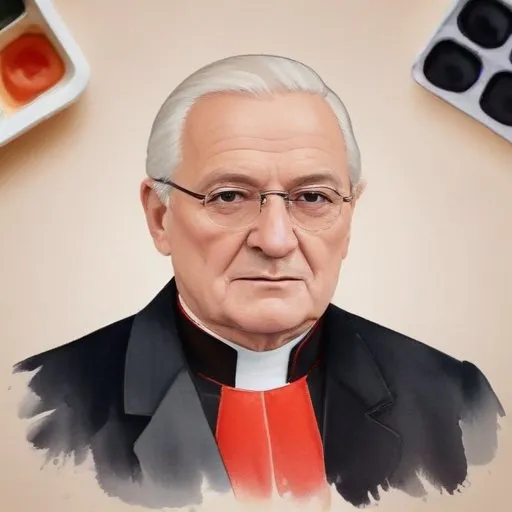
The 25th Superior General of the Society of Jesus, a German religious leader, oversaw the Jesuit order's global missionary and educational efforts, shaping Catholicism's modern face. He implemented reforms, strengthened the order's intellectual pursuits, and navigated complex Church politics.
Franz Xavier Wernz, a German Jesuit priest, is best known for his leadership as the 25th Superior General of the Society of Jesus, a position he held from 1906 until his death in 1914. During his tenure, he vigorously promoted the spiritual life, opened new missions, and created provinces around the world, making a significant impact on the Jesuit order.
Wernz was born on December 4, 1842, in Rottweil, Württemberg (now part of Germany), as the eldest of eight children. He entered the Society of Jesus on December 5, 1857, and made his novitiate at Gorheim near Sigmaringen. He took his first vows on December 8, 1859, and went on to study theology and philosophy at the Maria Laach and Aachen abbeys.
Wernz was a strong advocate for the spiritual life and encouraged Jesuit writers to take up the important work of historical research and documentation. He believed in the importance of promoting the spiritual life and spreading the mission of the Jesuit order around the world.
Wernz's leadership and vision for the Jesuit order had a significant impact on modern society, particularly in the areas of education and social justice. His promotion of the spiritual life and support for historical research and documentation have contributed to a greater understanding of the Jesuit order's role in history.
Franz Xavier Wernz's legacy is one of leadership, vision, and dedication to the Jesuit order. His commitment to promoting the spiritual life and supporting historical research has had a lasting impact on the order and its mission. Today, he is remembered as a significant figure in Jesuit history, and his contributions continue to inspire and guide the order.
90 Years Old
The 13th Superior General of the Society of Jesus, a Spanish priest, led the Jesuit order, promoting education, social justice, and interfaith dialogue, while navigating complex Church politics. He was a key figure in modernizing the Jesuit order.
Born in 1904
A German priest and theologian who sought to reconcile Catholicism with modern philosophy, exploring the intersection of faith and reason. His work greatly influenced 20th-century Catholic theology.
Born in 1905
A French cardinal and theologian who played a key role in shaping the Catholic Church's modernizing reforms of the 1960s, and was a leading voice in ecumenical dialogue .
Born in 1881
A French priest who merged spirituality with science, exploring the intersection of faith and evolution, and proposing a cosmic vision of human destiny. He's famous for his book "The Phenomenon of Man".
Born in 1886
A 20th-century theologian who redefined Christian doctrine with his emphasis on God's revelation and humanity's sinful nature, influencing modern Christian thought.
