


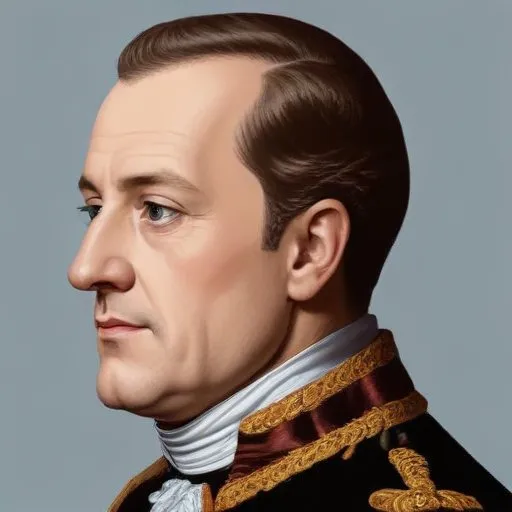
A German nobleman who ruled Brandenburg-Bayreuth from 1763 to 1769, known for his cultural achievements, including the construction of the Margravial Opera House.
Frederick Christian, Margrave of Brandenburg-Bayreuth, is best known for his unexpected ascension to the throne of Bayreuth in 1763, following the death of his nephew without an heir. This sudden rise to power marked a significant turning point in the history of Bayreuth, as Frederick Christian brought a new era of fiscal responsibility and administrative reform to the principality.
Born on July 17, 1708, in Weferlingen, Frederick Christian was the youngest of fourteen children to Margrave Christian Heinrich of Brandenburg-Bayreuth-Kulmbach and his wife, Countess Sophie Christiane of Wolfstein. His father passed away just three months before his birth, leaving his mother to raise him alongside his six surviving siblings.
After spending his early years in Denmark as a Lieutenant General, Frederick Christian was living in Wandsbek near Hamburg when his cousin, Georg Wilhelm, Margrave of Bayreuth, passed away in 1726. However, due to his absence and lack of preparation, his older brother, George Frederick Charles, took control of the principality of Bayreuth, leaving Frederick Christian on the sidelines.
It wasn't until the death of his nephew Frederick without an heir in 1763 that Frederick Christian found himself the only male member of the Bayreuth branch of the family, and subsequently, the new Margrave of Bayreuth.
Upon assuming power, Frederick Christian set out to stabilize the finances of the principality, which had been severely depleted. He implemented drastic cost-cutting measures, reducing the expenses of the Bayreuth court and halting most construction work on the castles and gardens. Many artists, including Carl von Gontard, fled to Berlin to seek patronage from King Frederick the Great.
While his reforms may have been seen as austere, they ultimately allowed Bayreuth to regain some semblance of stability, albeit at the cost of its former grandeur.
Frederick Christian married in Schaumburg an der Lahn on April 26, 1732, to a woman whose name is not recorded in historical accounts. The marriage produced no surviving issue, contributing to the eventual extinction of the Bayreuth branch of the House of Hohenzollern.
Frederick Christian's reign, though marked by frugality and caution, played a crucial role in preserving the principality of Bayreuth during a tumultuous period. His story serves as a testament to the unpredictable nature of power and the importance of adaptability in leadership.
Today, Frederick Christian's legacy is remembered as a turning point in the history of Bayreuth, marking the beginning of a new era of fiscal responsibility and administrative reform.
Born in 1657
King of Prussia from 1701 to 1713, crowned himself king, and established Berlin as his capital, transforming Prussia into a major power. He's known for his cultural and economic reforms.
Born in 1657
King of Prussia from 1701 to 1713, crowned himself king, and established Berlin as his capital, transforming Prussia into a major power. He's known for his cultural and economic reforms.
Born in 1688
The King of Prussia who ruled with an iron fist, centralizing power and modernizing the state, while also being a patron of the arts and architecture. He's known for his military reforms and frugal lifestyle.
Born in 1687
The queen consort of Frederick William I, known as the mother of Frederick the Great, was a key figure in 18th-century Prussian politics and a patron of the arts. She's infamous for her unhappy marriage and subsequent imprisonment.
Born in 1683
King of Great Britain and Ireland from 1727 to 1760, known for his military victories, particularly the Battle of Dettingen, and his role in the War of the Austrian Succession.
Born in 1670
A powerful Polish king who transformed his country into a major European power through military conquests and cultural achievements, earning him the nickname "the Strong".
