


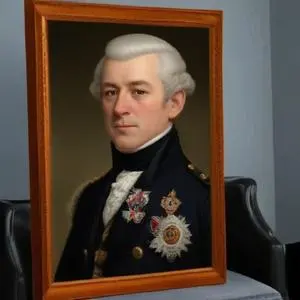
King of Prussia from 1797 to 1840, he ruled during the Napoleonic Wars and reformed the Prussian army, leading to its rise as a major European power. He's also known for his romantic poetry and music compositions.
Frederick William III, King of Prussia from 1797 until his death in 1840, is best known for his pivotal role in the Napoleonic Wars and his efforts to reform and unify the Protestant churches in Prussia. As a patron of the arts, he is also famous for being the dedicatee of Beethoven's iconic Ninth Symphony.
Born on August 3, 1770, in Potsdam, Frederick William was the son of Frederick William II of Prussia and Frederica Louisa of Hesse-Darmstadt. As a child, he was neglected by his father and suffered from an inferiority complex, which would affect him throughout his life. Despite this, he received a solid education, which laid the foundation for his future leadership.
Upon the death of his father in 1797, Frederick William ascended to the throne of Prussia. Initially, he maintained a policy of neutrality in the face of Napoleon's rising power, but eventually, he reluctantly joined the Sixth Coalition against Napoleon in the German campaign of 1813. Following Napoleon's defeat, he played a key role in the Congress of Vienna, shaping the post-Napoleonic order in Europe.
Frederick William's primary interests lay in internal reforms, particularly the unification of Prussia's Protestant churches. He aimed to create a centralized royal control of all Protestant churches in the Prussian Union of Churches, leading to a more homogeneous liturgy, organization, and architecture. His efforts were supported by his wife, Queen Louise, who led a group of influential advisors, including Baron Heinrich Friedrich Karl vom und zum Stein, Prince Karl August von Hardenberg, Gerhard von Scharnhorst, and Count August Neidhardt von Gneisenau. Together, they implemented significant reforms in Prussia's administration, churches, finance, and military.
Frederick William was known for his shyness and indecisiveness, which often made him rely on his wife, Queen Louise, as his most trusted political advisor. He was deeply devoted to her and valued her counsel greatly. Despite his reserved nature, he was a patron of the arts, as evident from his association with Beethoven and the dedication of the Ninth Symphony to him in 1824.
Frederick William III's legacy is complex and multifaceted. While he was instrumental in shaping the post-Napoleonic order in Europe, his internal reforms had a lasting impact on Prussia's administration, churches, and military. As a patron of the arts, he encouraged the growth of cultural institutions and supported some of the most prominent artists of his time. Despite his personal limitations, he played a significant role in European history, leaving behind a lasting legacy that continues to influence modern society.
Through his complex and often contradictory personality, Frederick William III left an indelible mark on European history. As a reluctant reformer and patron of the arts, he continues to fascinate and inspire, offering a unique window into the tumultuous world of 19th-century Europe.
Born in 1712
Prussian king who ruled with Enlightenment values, promoting arts, education, and religious tolerance, while also being a skilled military strategist and expanding his kingdom through wars.
Born in 1729
Empress of Russia from 1762 to 1796, she transformed her country into a major European power, modernizing its culture, politics, and economy through numerous reforms and conquests.
Born in 1769
A French military leader who rose to prominence during the French Revolution and became Emperor of France, known for his military conquests and reorganization of Europe. He is also famous for his Napoleonic Code, which remains a foundation of modern law.
