


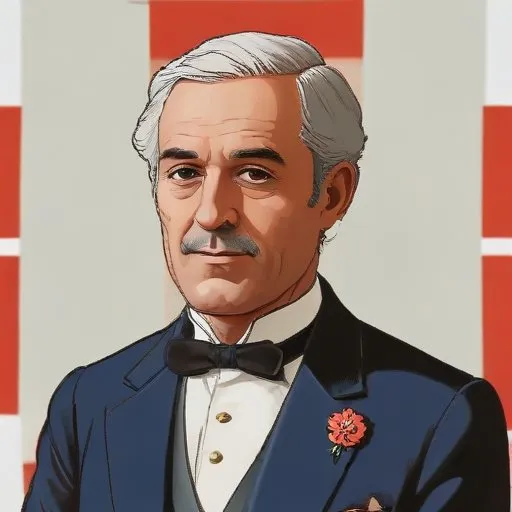
A British aristocrat who played cricket and served as Governor General of Canada, known for his diplomatic efforts during World War I. He's also remembered for his role in shaping Canada's autonomy.
Freeman Freeman-Thomas, 1st Marquess of Willingdon, was a British Liberal politician and administrator who served as Governor General of Canada and Viceroy and Governor-General of India, leaving an indelible mark on the British Empire in the early 20th century. His illustrious career spanned over four decades, earning him a reputation as a skilled diplomat, administrator, and statesman.
Born on September 12, 1866, in England, Freeman-Thomas was educated at Eton College and the University of Cambridge. After completing his education, he served for 15 years in the Sussex Artillery, developing the leadership skills that would serve him well in his future endeavors.
Freeman-Thomas' entry into politics began in 1900 when he was elected to the British House of Commons. He subsequently held various government posts, including secretary to the British prime minister and Lord-in-waiting to King George V. His diplomatic career took off in 1913 when he was appointed Governor of Bombay, followed by the governorship of Madras.
In 1926, he was appointed as the Governor-General of Canada, a position he held until 1931. During his tenure, he played a significant role in fostering Canadian autonomy and strengthening ties between Canada and the United Kingdom. He was succeeded by the Earl of Bessborough in 1931.
In 1931, Freeman-Thomas was appointed as Viceroy and Governor-General of India, succeeding Lord Irwin (later created Earl of Halifax). He served in this position until 1936, playing a crucial role in shaping India's transition to independence. He was succeeded by the Marquess of Linlithgow in 1936.
After the end of his viceregal tenure, Freeman-Thomas was installed as the Lord Warden of the Cinque Ports and elevated in the peerage as the Marquess of Willingdon. He represented Britain at various international organizations and celebrations, solidifying his reputation as a seasoned diplomat and statesman.
Freeman-Thomas passed away on August 12, 1941, at his home in London. His ashes were interred in Westminster Abbey, a testament to his lifelong dedication to public service.
Freeman Freeman-Thomas, 1st Marquess of Willingdon, left an enduring legacy in the realms of diplomacy, politics, and administration. His leadership and diplomatic skills played a significant role in shaping the British Empire's relations with its dominions and colonies. His commitment to public service and his ability to navigate complex political landscapes have made him a revered figure in British history.
Today, Freeman Freeman-Thomas, 1st Marquess of Willingdon, is remembered as a dedicated public servant, a skilled diplomat, and a champion of Dominion autonomy. His life's work serves as a testament to the power of dedicated public service and the enduring impact it can have on the world.
Born in 1874
A Canadian lawyer and politician who served as the 9th Prime Minister of Canada, known for his strong leadership during World War I and his role in shaping Canada's autonomy.
Born in 1870
The 11th Prime Minister of Canada, a lawyer-turned-politician who led the country through the Great Depression, implementing policies to alleviate economic suffering. He's known for his efforts to establish a Canadian welfare state.
Born in 1874
The tenth Prime Minister of Canada, serving for a record 22 years, is most known for leading the country through significant periods of economic and social change, including the Great Depression and World War II.
Born in 1882
The 12th Prime Minister of Canada, a strong leader who played a crucial role in shaping the country's post-war economy and foreign policy, and is credited with establishing universal hospital insurance and old-age pensions.
Born in 1897
A Canadian leader who served as Prime Minister and won the Nobel Peace Prize for resolving the Suez Canal Crisis, known for his diplomatic efforts and peacekeeping initiatives.
Born in 1919
The charismatic leader who championed Canadian unity and implemented progressive policies, known for his iconic style and influential legacy in shaping modern Canada.
92 Years Old
The 20th Prime Minister of Canada, serving from 1993 to 2003, known for his leadership during the Quebec sovereignty movement and his role in shaping Canada's national unity. He implemented policies like the Clarity Act and the National Child Benefit.
45 Years Old
American professional ice hockey player who won two Stanley Cup championships and was a four-time NHL All-Star. Known for his rugged defensive play and physical presence on the ice.
