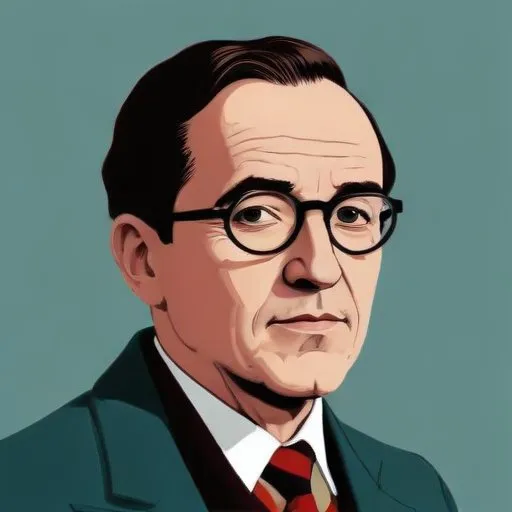
Geoffrey Grigson: The Visionary Poet and Editor
A Renaissance Man of Letters
Geoffrey Edward Harvey Grigson, born on 2 March 1905, was a British poet, writer, editor, critic, exhibition curator, anthologist, and naturalist who left an indelible mark on the literary world. With a career spanning multiple decades, Grigson was instrumental in shaping the course of modern poetry, criticism, and art, earning him a reputation as a fierce intellect and a champion of avant-garde thought.
The Early Years: A Cornish Upbringing
Grigson's childhood in rural Cornwall had a profound influence on his work, instilling in him a deep love for nature and its rhythms. Born at the vicarage in Pelynt, near Looe, Cornwall, Grigson's early years were spent surrounded by the rugged beauty of the Cornish landscape, which would later inform his poetry and writing.
Poetic Beginnings: New Verse and Beyond
After graduating from Oxford University, Grigson took up a job at the London office of the Yorkshire Post before becoming literary editor of the Morning Post. It was during this period that he first gained recognition as a poet, particularly through his work with the influential poetry magazine New Verse, which he edited from 1933 to 1939. New Verse featured the work of prominent poets such as
Louis MacNeice,
Stephen Spender,
Dylan Thomas,
W. H. Auden, and Paul Éluard, as well as Grigson's own poetry.
A Collection of Diverse Talents
Grigson's remarkable range of interests and talents extended far beyond poetry and criticism. He was an accomplished exhibition curator, anthologist, and naturalist, publishing numerous works on art, travel, and the countryside. His involvement in the London International Surrealist Exhibition at New Burlington Galleries in 1936 and the co-founding of the Institute of Contemporary Arts in 1946 attested to his commitment to avant-garde innovation.
Autobiography and Legacy
Grigson's autobiography, The Crest on the Silver, published in 1950, offered a candid and introspective account of his life and career. Throughout his life, Grigson was known for his fierce intellect, his unwavering commitment to his artistic vision, and his unrelenting criticism of the establishment. Despite making many literary enemies, Grigson's contributions to modern poetry, art, and criticism continue to inspire and provoke.
Teaching, Journalism, and Broadcasting
At various points in his career, Grigson was involved in teaching, journalism, and broadcasting, sharing his vast knowledge and expertise with a wider audience. His ability to communicate complex ideas with clarity and precision made him a respected figure in these fields.
PERSONAL MILESTONES AND KEY LIFE EVENTS
- Born on 2 March 1905, at the vicarage in Pelynt, near Looe, Cornwall
- Graduated from Oxford University
- Edited New Verse from 1933 to 1939
- Co-founded the Institute of Contemporary Arts in 1946
- Published The Crest on the Silver in 1950
- Died on 25 November 1985
CONTROVERSIES AND PUBLIC PERCEPTION
Grigson's fierce intellect and unyielding commitment to his artistic vision often led to controversy and public debate. His scathing critiques of the establishment and his unapologetic promotion of avant-garde thought earned him both admiration and criticism from his contemporaries.
MEMORABLE SAYINGS AND QUOTES
- "The poet is not a philosopher, but a seer."
- "Art is the only thing that can save us from ourselves."
HYSTERICAL CONTEXT AND LEGACY
Grigson's contributions to modern poetry, art, and criticism continue to influence contemporary thought and artistic expression. His commitment to avant-garde innovation and his unwavering dedication to his artistic vision have made him a figure of enduring importance in the literary world.
CAREER HIGHLIGHTS AND MAJOR WORKS
- Publisher of 13 poetry collections
- Editor of New Verse (1933-1939)
- Author of numerous anthologies on art, travel, and the countryside
- Co-founder of the Institute of Contemporary Arts (1946)
EDUCATIONAL CONTRIBUTIONS AND INFLUENCE
Grigson's extensive knowledge and expertise in poetry, art, and criticism have had a lasting impact on education and the arts. His commitment to sharing his knowledge with others has inspired generations of writers, artists, and critics.