


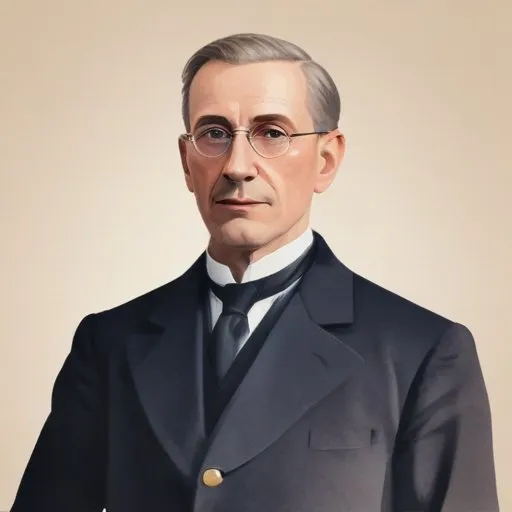
A German physicist and academic who made significant contributions to the fields of electricity, magnetism, and optics, and is particularly renowned for his work on the discovery of the Quincke tube.
Georg Hermann Quincke, a German physicist, is renowned for his groundbreaking contributions to the field of physics, particularly in the study of capillary phenomena and the invention of the Interference Tube. This innovative apparatus, built in 1866, demonstrates the destructive interference of sound waves, a concept that has since been applied in various noise management devices, including mufflers.
Born on November 19, 1834, in Frankfurt an der Oder, Germany, Quincke was the son of prominent physician Hermann Quincke and the elder brother of physician Heinrich Quincke. He pursued his academic interests at the University of Berlin, where he received his Ph.D. in 1858. Quincke's dissertation focused on the capillary constant of mercury, setting the stage for his future research endeavors.
Quincke's academic career was marked by significant milestones. He became a privatdocent at the University of Berlin in 1859, and by 1865, he was appointed as a professor. In 1872, he moved to the University of Würzburg, and later, in 1875, he took up a professorship at the University of Heidelberg, where he remained until his retirement in 1907.
Quincke's research activities were far-reaching, encompassing the study of capillary phenomena, the reflection of light, and the influence of electric forces on the constants of matter. His work on the dissociation hypothesis of Clausius also contributed significantly to the field.
The Interference Tube, also known as the Herschel-Quincke Tube, is an apparatus that showcases Quincke's ingenuity. Although John Herschel had proposed a similar device, Quincke was the first to build and demonstrate its functionality. This invention has since found applications in noise management and has become a fundamental concept in physics.
Quincke received numerous honors and accolades during his lifetime. He was elected an honorary fellow of the Royal Society of London and was awarded honorary degrees from the University of Oxford, University of Cambridge, and University of Glasgow. In 1885, he published a historical account of the Physical Institute of the University of Heidelberg, titled "Geschichte des physikalischen Instituts der Universität Heidelberg."
Georg Hermann Quincke passed away on January 13, 1924, at the age of 89, leaving behind a legacy of innovation and discovery. As one of the last living participants of the Karlsruhe Congress, Quincke's contributions to physics continue to inspire and influence future generations of scientists and researchers.
Born in 1821
A 19th-century physician and physicist who made significant contributions to the fields of electromagnetism, thermodynamics, and the physiology of human perception, particularly in the study of vision and hearing.
Born in 1831
Developed groundbreaking theories that unified electricity and magnetism, and predicted the existence of radio waves, revolutionizing our understanding of the physical world.
Born in 1804
Developed the first electromagnetic theory of light and made significant contributions to the understanding of electricity and magnetism. He's also credited with inventing the first electromagnetic telegraph.
Born in 1824
Developed fundamental laws of thermodynamics and electromagnetism, shaping our understanding of energy and its interactions.
Born in 1832
Developed the Lipschitz continuity condition, a fundamental concept in mathematical analysis, and contributed significantly to number theory and algebra. His work laid the groundwork for modern calculus and functional analysis.
Born in 1857
A pioneer in the field of electromagnetism, he discovered radio waves and proved James Clerk Maxwell's theories, paving the way for modern wireless communication. His experiments led to the development of radio, television, and mobile phones.
Born in 1864
Developed groundbreaking geometric methods that transformed our understanding of space and time, and his work laid the foundation for Einstein's theory of relativity.
