


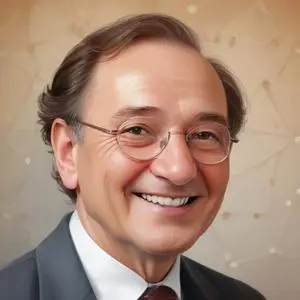
Developed groundbreaking methods for synthesizing and studying carbocations, earning a Nobel Prize in Chemistry in 1994 for his work on hydrocarbons. His research revolutionized the field of organic chemistry.
George Andrew Olah, a Hungarian-American chemist, is renowned for his groundbreaking research on the generation and reactivity of carbocations via superacids, earning him the Nobel Prize in Chemistry in 1994. His work has had a profound impact on the field of chemistry, revolutionizing our understanding of chemical reactions and reactivity.
Born on May 22, 1927, in Budapest, Hungary, to a Jewish couple, Magda Krasznai and Gyula Olh, a lawyer, Olah's academic pursuits began at the Budapesti Piarist Gimnazium. He then went on to study under renowned organic chemist Gza Zempln at the Technical University of Budapest, where he earned his M.S. and Ph.D. degrees in chemical engineering.
Olah's illustrious career spanned across multiple institutions, including the Technical University of Budapest, where he taught as a professor of organic chemistry from 1949 to 1954. He later worked at the research institute of the Hungarian Academy of Sciences from 1954 to 1956. Following the 1956 Hungarian Revolution, Olah emigrated to England and eventually settled in Canada, where he joined Dow Chemical in Sarnia, Ontario. It was during his time at Dow that he initiated his pioneering work on carbocations.
In 1965, Olah returned to academia, joining Case Western Reserve University in Cleveland, Ohio, where he chaired the department of chemistry from 1965 to 1969. He held the C. F. Maybery Distinguished Professor of Research in Chemistry position from 1967 to 1977. Throughout his career, Olah published numerous papers and patents, cementing his reputation as a leading figure in the field of chemistry.
Olah's work has had a profound impact on the field of chemistry, enabling the development of new classes of compounds and reaction pathways. His research has far-reaching implications in fields such as materials science, catalysis, and environmental chemistry. Olah's legacy continues to inspire future generations of chemists, solidifying his position as one of the most influential chemists of the 20th century.
George Andrew Olah's remarkable journey, marked by perseverance, innovation, and dedication, serves as a testament to the power of human ingenuity and the boundless potential of the human spirit.
Born in 1901
Pioneering chemist and peace activist who won two unshared Nobel Prizes, one for chemistry and one for peace, for his groundbreaking work on the nature of the chemical bond and his tireless efforts to promote nuclear disarmament.
Born in 1912
A renowned chemist and academic who discovered and isolated ten transuranic elements, including plutonium, and was a leading figure in the development of nuclear energy. His work had a profound impact on our understanding of the periodic table and the properties of atomic nuclei.
Born in 1893
A pioneering scientist who discovered deuterium, a heavy isotope of hydrogen, and later contributed to the discovery of many other elements, revolutionizing our understanding of the universe.
Born in 1868
Developed a process to synthesize ammonia, revolutionizing agriculture and warfare, and was awarded the Nobel Prize in Chemistry in 1918.
Born in 1917
A Nobel Prize-winning scientist who developed the theory of dissipative structures, which explains how complex systems can self-organize and evolve over time. His work has far-reaching implications for fields like chemistry, biology, and ecology.
Born in 1918
Organic chemist and Nobel laureate who developed a new way to synthesize complex molecules, revolutionizing the field of chemistry. His work led to the creation of new medicines and materials.
98 Years Old
Developed innovative synthetic methods, transforming organic chemistry and enabling the creation of complex molecules with precise structures.
84 Years Old
Developed groundbreaking catalysts that enabled efficient and environmentally friendly production of complex molecules, revolutionizing the field of organic chemistry.
