


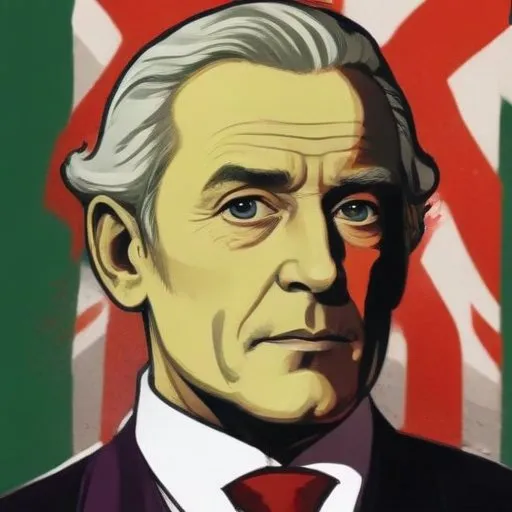
An Irish-English politician and diplomat who played a key role in shaping British foreign policy, particularly in China, and served as Governor of Grenada. He's most known for leading a historic British embassy to China in 1793.
George Macartney, 1st Earl Macartney, is often remembered for his astute observation that Britain now controlled a vast empire "on which the sun never sets," following Britain's victory in the Seven Years War and subsequent territorial expansion at the Treaty of Paris. As a seasoned diplomat and statesman, Macartney played a pivotal role in shaping the British Empire's expansion, serving as the governor of Grenada, Madras, and the British-occupied Cape Colony.
Born on May 14, 1737, as the only son of George Macartney, High Sheriff of Antrim, and Elizabeth Winder, Macartney descended from a Scottish family with origins in Ireland. He was granted land in Scotland for serving under Edward Bruce, brother of Robert the Bruce. After graduating from Trinity College Dublin in 1759, he became a student of the Temple, London, where he forged connections that would shape his future in politics.
Macartney's diplomatic career began in 1764 when he was appointed envoy extraordinary to Russia, where he successfully negotiated an alliance between Great Britain and Russia with Catherine II. This marked the beginning of his illustrious career, which saw him return to the Irish House of Commons as a Member of Parliament for Armagh Borough in 1768, and subsequently becoming the Chief Secretary for Ireland.
In 1775, Macartney became the governor of the British West Indies, and in 1776, he was created Baron Macartney in the Peerage of Ireland. During his tenure as governor of Grenada from 1776 to 1779, the island was attacked by the French royal fleet of the Comte d'Estaing in July 1779. Despite losing control of the fortifications on Hospital Hill, Macartney's leadership and diplomacy played a crucial role in maintaining British control over the island.
Macartney's contributions to the British Empire's expansion and his diplomatic prowess earned him a place in history as one of the most influential statesmen of his time. His observation about the vastness of the British Empire has become an enduring symbol of British power and influence. Today, his legacy serves as a testament to the complexities and intricacies of diplomacy, politics, and colonialism during the 18th century.
Through his remarkable career, Macartney demonstrated exceptional leadership, negotiation skills, and vision, earning him a reputation as a skilled statesman and diplomat. As the British Empire continues to fascinate and intrigue historians and scholars, Macartney's life and achievements serve as a powerful reminder of the complexities and nuances of colonialism and imperialism.
Macartney's contemporaries, such as Charles James Fox and Lord Holland, played significant roles in shaping British politics and diplomacy during the late 18th century. While Macartney's diplomatic career was marked by his ability to forge alliances and negotiate treaties, his contemporaries were instrumental in shaping British foreign policy and domestic politics.
In conclusion, George Macartney, 1st Earl Macartney, was a remarkable statesman and diplomat whose contributions to the British Empire's expansion continue to fascinate and intrigue historians and scholars. His life and achievements serve as a testament to the complexities and nuances of colonialism, imperialism, and diplomacy during the 18th century.
Born in 1749
A prominent 18th-century politician who championed individual liberties and opposed British imperialism, known for his charismatic oratory skills and influential foreign policy decisions.
Born in 1759
Prime Minister of the United Kingdom from 1783 to 1801 and 1804 to 1806, known for leading the country through the French Revolutionary and Napoleonic Wars.
Born in 1729
An 18th-century thinker who shaped modern conservatism, advocating for gradual social change and warning against the dangers of radical revolution. He's also known for his philosophical writings on aesthetics and the sublime.
Born in 1732
British colonial administrator who oversaw the consolidation of British power in India, implementing reforms and expanding the empire, while also being accused of corruption and abuse of power.
Born in 1725
Chancellor of the Exchequer who imposed taxes on British American colonies, sparking widespread protests and contributing to the American Revolution.
Born in 1738
The British monarch who ruled during the American Revolution, losing the colonies, and later suffered a mental illness that led to a regency crisis. He's also known for his cultural and artistic patronage.
