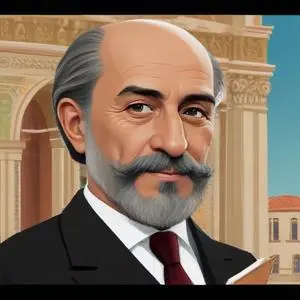
George Santayana: The Philosopher of Insightful Aphorisms
Known for His Timeless Wisdom
George Santayana, a Spanish-American philosopher, essayist, poet, and novelist, is renowned for his profound aphorisms that continue to resonate with scholars and laymen alike. His crisp, piercing insights into human nature, morality, and the human condition have made him a household name, with quotes like "Those who cannot remember the past are condemned to repeat it" and "Only the dead have seen the end of war" becoming an integral part of popular culture.
Early Life and Education
Born on December 16, 1863, in Madrid, Spain, Santayana spent his early childhood in Ávila, Spain. His mother, Josefina Borrs, was the daughter of a Spanish official in the Philippines, and he was the only child of her second marriage. After his parents moved to the United States when he was eight, Santayana was raised and educated in Boston, identifying himself as an American despite retaining a valid Spanish passport.
Academic Pursuits and Philosophical Contributions
Santayana's philosophical contributions were rooted in his critique of modern society, which he believed was trapped in a cycle of materialism and moral decay. His work spanned multiple disciplines, including philosophy, literature, and cultural criticism. He was a prolific writer, producing several influential works, including:
- (1896), a treatise on aesthetics
- The Life of Reason (1905-1906), a five-volume philosophical work
- Soliloquies in England (1922), a collection of philosophical essays
- The Last Puritan (1935), a novel that explores American identity
Influence on Modern Society
Santayana's ideas have had a lasting impact on modern society, influencing thinkers and writers across various disciplines. His concept of "animal faith," which posits that human beings have an innate, instinctual capacity for faith, has been particularly influential in the fields of philosophy, psychology, and theology.
Personal Milestones and Key Life Events
At the age of 48, Santayana left his position at Harvard University, where he had taught philosophy since 1889, and returned to Europe permanently. He never married and had no children, dedicating his life to his work and intellectual pursuits.
Philosophical Beliefs and Controversies
Santayana was an atheist, yet he cherished the Spanish Catholic values and worldview in which he was raised. His critique of modern society was often seen as controversial, earning him both praise and criticism from his contemporaries.
Quotes and Memorable Sayings
Santayana's aphorisms continue to inspire and provoke, offering insights into the human condition:
- "Those who cannot remember the past are condemned to repeat it."
- "Only the dead have seen the end of war."
- "Beauty is pleasure objectified."
Legacy and Historical Context
Santayana's legacy extends beyond his philosophical contributions, with his work influencing literature, art, and culture. He remains a significant figure in the intellectual history of the 20th century, with his ideas continuing to resonate with scholars and the general public alike.
Predictions and Speculations
In his later years, Santayana predicted that modern society would eventually collapse under the weight of its own materialism and moral decay. While his predictions were dire, they serve as a warning, reminding us of the importance of critical thought and moral reflection.
Visual Timeline and Milestones
- 1863: Born in Madrid, Spain
- 1869: Moved to the United States with his mother
- 1889: Began teaching philosophy at Harvard University
- 1905-1906: Published The Life of Reason
- 1912: Left Harvard University and returned to Europe permanently
- 1952: Died in Rome, Italy, and was buried in the Spanish Pantheon
Inspirational Stories and Motivations
Santayana's life and work serve as a testament to the power of intellectual curiosity and critical thought. His dedication to his craft, despite facing criticism and controversy, is a reminder that true wisdom requires courage, perseverance, and a willingness to challenge the status quo.