


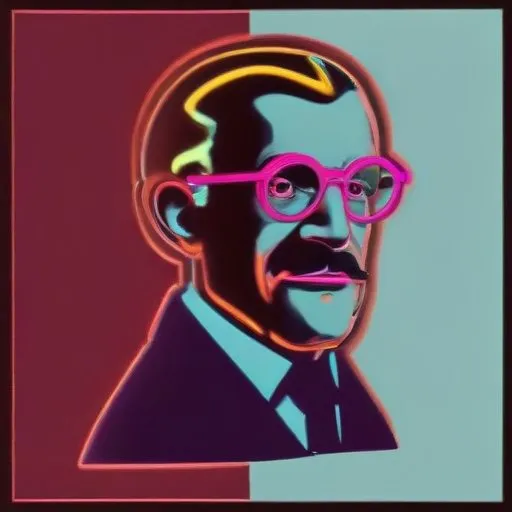
A French chemist and engineer credited with inventing neon lighting, revolutionizing outdoor advertising and urban landscapes with vibrant, glowing signs. His innovation transformed the visual identity of cities worldwide.
Georges Claude, a French engineer and inventor, is renowned for his groundbreaking work on industrial liquefaction of air, pioneering neon lighting, and experimenting with generating energy from cold seawater. He is often regarded as the Edison of France, a testament to his remarkable contributions to the fields of science and technology.
Born on September 24, 1870, in Paris, France, during the city's siege by German forces, Claude's early life was marked by turmoil. Despite these circumstances, he went on to study at the esteemed École Supérieure de Physique et de Chimie Industrielles de la Ville de Paris (ESPCI), laying the foundation for his future accomplishments.
In 1902, Claude developed the Claude system for liquefying air, a pioneering achievement that enabled the production of industrial quantities of liquid nitrogen, oxygen, and argon. This innovation rivaled the earlier system of Carl von Linde (1895) and paved the way for the creation of Air Liquide, a multinational corporation headquartered in Paris, France, which he co-founded with businessman Paul Delorme.
Inspired by Geissler tubes and Daniel McFarlan Moore's invention of the nitrogen-based light (Moore tube), Claude turned his attention to neon lighting. His work in this area led to the development of commercial neon signs, transforming urban landscapes and revolutionizing advertising.
Claude's curiosity and inventive spirit also led him to experiment with generating energy by pumping cold seawater up from the depths. Although this ambitious project did not yield the desired results, it demonstrated his tireless pursuit of innovation and his commitment to improving the world around him.
Claude's active collaboration with German occupiers during World War II led to his imprisonment in 1945 and the stripping of his honors. Despite this setback, his legacy as a pioneering inventor and scientist continues to inspire generations.
Born in 1856
A pioneering engineer who harnessed the power of alternating current (AC) to transform the world's electrical systems, and is credited with developing groundbreaking technologies like radio communication and X-ray imaging.
Born in 1847
A pioneer in innovation, credited with developing groundbreaking inventions that revolutionized the way people live and communicate, including the light bulb and phonograph.
Born in 1874
Developer of the first practical wireless telegraph, pioneering radio communication and earning a Nobel Prize in Physics. Known for revolutionizing long-distance communication.
Born in 1847
A Scottish-American engineer and academic credited with inventing the telephone, revolutionizing real-time communication. This innovation transformed the way people connect and conduct business.
Born in 1853
Developed groundbreaking inventions and innovations in electrical engineering, including the first practical welding machine and the first electric streetcar system.
Born in 1816
Founded the multinational conglomerate Siemens, revolutionizing telecommunications and electrical engineering with groundbreaking inventions like the dynamo and electric tramway. He transformed the industry with innovative solutions and entrepreneurial spirit.
Born in 1857
A pioneer in the field of electromagnetism, he discovered radio waves and proved James Clerk Maxwell's theories, paving the way for modern wireless communication. His experiments led to the development of radio, television, and mobile phones.
Born in 1831
Developed groundbreaking theories that unified electricity and magnetism, and predicted the existence of radio waves, revolutionizing our understanding of the physical world.
