


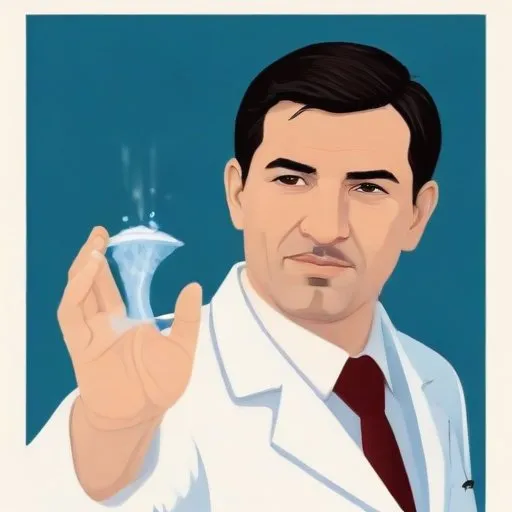
A Greek-American pathologist who developed a simple, non-invasive test to detect cervical cancer, revolutionizing women's health and saving countless lives.
Georgios Papanikolaou is best known for inventing the Pap smear, a revolutionary screening test for cervical cancer that has saved countless lives around the world. As a Greek physician, zoologist, and microscopist, Papanikolaou dedicated his life to finding innovative ways to detect and prevent cancer, earning him a place in the annals of medical history.
Born on May 13, 1883, in Kymi, Greece, Papanikolaou's fascination with science and medicine began at an early age. He studied literature, philosophy, languages, and music at the University of Athens before pursuing a medical degree, which he received in 1904. After serving in the military, Papanikolaou continued his education in Germany, studying under prominent scientists such as Ernst Haeckel and August Weismann.
In 1928, Papanikolaou made a groundbreaking discovery that would change the face of cancer detection. He found that uterine cancer cells could be detected in vaginal smears, paving the way for the development of the Pap smear. Although his work was initially met with skepticism, it eventually gained recognition in the 1940s, and by the 1950s, extensive trials were being conducted to test his techniques.
In 1913, Papanikolaou immigrated to the United States, where he joined the faculty at Cornell Medical College. He worked in the Department of Pathology at New York Hospital and the Department of Anatomy at Cornell Medical College, continuing his research in cytopathology. His wife, Andromachi Mavrogeni, was not only his partner in life but also his laboratory assistant and research subject.
Papanikolaou's invention of the Pap smear has had a profound impact on women's health worldwide. The Pap smear has become a routine screening test, enabling early detection and prevention of cervical cancer. His work has saved countless lives and has been recognized with numerous awards and honors. In 1961, he was invited to lead the Papanicolaou Cancer Research Institute at the University of Miami, a testament to his enduring legacy in the field of cancer research.
Papanikolaou's life was marked by several significant milestones, including his marriage to Andromachi Mavrogeni in 1910 and their immigration to the United States in 1913. He passed away on February 19, 1962, leaving behind a legacy that continues to inspire generations of scientists and medical professionals.
"The microscope is a sacred instrument, and we must use it to unlock the secrets of nature."
"Cancer is a curable disease, and we must strive to detect it early to save lives."
Georgios Papanikolaou's groundbreaking work in cytopathology and cancer detection has left an indelible mark on the medical community. His legacy serves as a testament to the power of innovation and dedication in improving human health.
Born in 1869
Developed a method for microanalysis of organic compounds, earning the Nobel Prize in Chemistry in 1923 for his innovative work in analytical chemistry.
Born in 1898
A high-ranking officer in the German Wehrmacht during World War II, known for his involvement in the July 20 plot to assassinate Adolf Hitler.
Born in 1883
A German physiologist and physician who discovered that cancer cells generate energy through anaerobic metabolism, earning him the Nobel Prize in Physiology or Medicine in 1931. His work laid the foundation for modern cancer research.
Born in 1902
Pioneering geneticist who discovered transposons, mobile genetic elements that jump from one location to another in a genome, revolutionizing our understanding of genetic variation and evolution.
