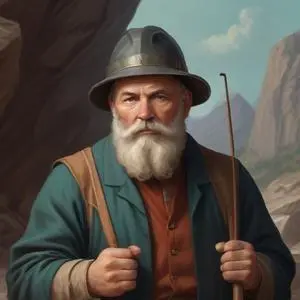
Georgius Agricola: The Father of Mineralogy and Founder of Geology
The Pioneering Work of a Renaissance Scholar
Georgius Agricola, born Georg Bauer, is renowned for his groundbreaking contributions to the fields of mineralogy and geology, earning him the title of "Father of Mineralogy" and "Founder of Geology as a Scientific Discipline." His most notable work,
De Natura Fossilium, published in 1546, laid the foundation for modern geology and mineralogy.
Early Life and Education
Born on March 24, 1494, in Glauchau, Electorate of Saxony, Holy Roman Empire, Agricola received a broad education, which sparked his interest in mining and refining metals. This curiosity led him to explore the fields of chemistry, metallurgy, and mineralogy, ultimately shaping his future contributions.
Contributions to Mineralogy and Geology
Agricola's
De Natura Fossilium is considered a seminal work in the history of geology. This comprehensive treatise classified fossils, rocks, and minerals, providing a systematic approach to understanding the natural world. His work also introduced the term "chemistry" in its modern sense, dropping the Arabic definite article "al" and using "chymia" and "chymista" to describe chemical and alchemical practices.
De re metallica libri XII: A Comprehensive Guide to Mining and Metallurgy
Agricola's posthumously published work,
De re metallica libri XII, is a 12-volume magnum opus that coveres all aspects of mining, mining sciences, and metallurgy. This unparalleled work served as the standard reference for two centuries, offering a systematic and methodical approach to the fields. Agricola's commitment to observational research and his exclusion of unsubstantiated claims ensured the accuracy and reliability of his work.
Broad Intellectual Pursuits
Agricola's scholarly pursuits extended beyond mineralogy and geology. He published over 40 works on diverse subjects, including pedagogy, medicine, metrology, mercantilism, pharmacy, philosophy, history, and more. This Renaissance scholar's commitment to universal learning and research embodied the essence of the Renaissance humanist spirit.
Legacy and Impact
Agricola's contributions have had a lasting impact on the development of geology and mineralogy as scientific disciplines. His emphasis on observational research, systematic classification, and precise methods of production and control have influenced generations of scholars and scientists. His work continues to inspire new discoveries and advancements in the fields of earth sciences, chemistry, and metallurgy.
Personal Milestones and Key Life Events
- March 24, 1494: Born in Glauchau, Electorate of Saxony, Holy Roman Empire
- 1546: Published De Natura Fossilium, a foundational work in geology and mineralogy
- 1555: Passed away on November 21
- 1556: Posthumous publication of De re metallica libri XII, a comprehensive guide to mining and metallurgy
Quotes and Memorable Sayings
"In this work, I have excluded all those things which I have not myself seen, or have not read or heard of." - Georgius Agricola, De re metallica libri XII
Historical Context and Legacy
Agricola's work occurred during the Renaissance, a period of cultural, artistic, scientific, and philosophical transformation in Europe. His contributions reflect the intellectual curiosity and innovative spirit of this era, paving the way for future scientific breakthroughs and discoveries. As the "Father of Mineralogy" and "Founder of Geology," Agricola's legacy continues to inspire and influence scholars and scientists across disciplines.
FAQ
What was Georgius Agricolas contribution to the field of mineralogy?
Georgius Agricola was a German mineralogist and scholar who is considered the father of mineralogy. He wrote the seminal work De Natura Fossilium, which laid the foundations for modern mineralogy and geology.
What was Georgius Agricolas approach to scientific inquiry?
Georgius Agricolas approach to scientific inquiry was characterized by a combination of observation, experimentation, and rigorous analysis. He believed in the importance of empirical evidence and the value of systematic classification.
How did Georgius Agricolas work influence later scientists?
Georgius Agricolas work influenced later scientists like Carl Linnaeus and James Hutton, who built upon his foundations in mineralogy and geology. His work also inspired later generations of scientists to pursue systematic classification and empirical research.
What was Georgius Agricolas role in the Renaissance humanist movement?
Georgius Agricola was a prominent figure in the Renaissance humanist movement, which sought to revive classical knowledge and values. He saw his work in mineralogy as part of a broader effort to understand and appreciate the natural world.
What is Georgius Agricolas legacy in modern science?
Georgius Agricolas legacy in modern science is that of a pioneering scholar who laid the foundations for modern mineralogy and geology. He is remembered as a champion of empirical research, systematic classification, and intellectual curiosity.