


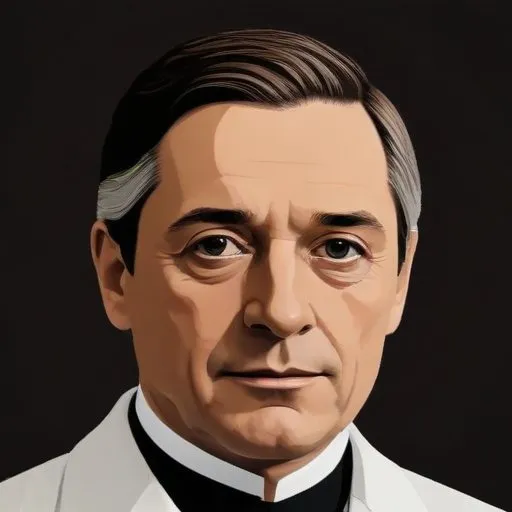
A German academic and politician who served as the 7th Chancellor of the German Empire, known for his brief but significant tenure during World War I. He played a crucial role in shaping Germany's war efforts and politics during a tumultuous period.
Georg von Hertling, a prominent figure in German politics, is renowned for being the first party politician to hold the offices of Chancellor of the German Reich and Minister President of Prussia simultaneously. Born on August 31, 1843, in Darmstadt, Hesse, von Hertling's remarkable journey was marked by his unwavering commitment to the Catholic Centre Party and his eventual rise to the top of German politics.
Von Hertling was born into a Catholic family of civil servants, where his mother's strong religious influence led him to consider priesthood. However, he pursued a career in philosophy instead, studying at the University of Munich, Münster, and Berlin. He received his doctorate in 1864 and became a qualified professor in 1867, but due to the Kulturkampf, he faced difficulties in securing a professorship until 1880.
Von Hertling's political career began in 1875 when he was elected to the Reichstag as a member of the Catholic Centre Party. He swiftly rose through the ranks, becoming the Foreign Minister of Bavaria in 1912 and Minister President of Bavaria in 1914. On November 1, 1917, he was appointed Chancellor of the German Reich and Minister President of Prussia, a dual role that no party politician had held before.
During his tenure as Chancellor, von Hertling faced the immense challenge of navigating Germany through the tumultuous final year of World War I. Despite his efforts, his government eventually collapsed in September 1918, and he resigned as Chancellor. His conservative stance, which prioritized the emperor's authority over parliamentary power, was a significant factor in his downfall.
Von Hertling's legacy is complex, marked by both admiration and criticism. While he played a crucial role in shaping German politics, his conservative views and resistance to parliamentary reforms have been subject to scrutiny. Nonetheless, his commitment to the Catholic Centre Party and his unwavering dedication to his principles have earned him a place in the annals of German history.
Von Hertling's personal life was marked by his strong Catholic faith, which significantly influenced his political decisions. He once remarked, "I am a politician, but I am also a Christian, and I will not sacrifice my faith for politics." This quote reflects his unyielding commitment to his principles, which defined his life and career.
Von Hertling's remarkable life serves as a testament to the complexities of politics and the power of unwavering conviction. While his legacy may be subject to interpretation, his dedication to the Catholic Centre Party and his commitment to his principles remain an integral part of German history.
Born in 1856
A German lawyer and politician who served as the 5th Chancellor of Germany from 1909 to 1917, known for his role in leading Germany into World War I. He implemented policies that led to the war, including the invasion of neutral Belgium, which drew Britain into the conflict.
Born in 1849
A German Chancellor who served from 1900 to 1909, known for his aggressive foreign policy and role in escalating tensions leading to World War I.
Born in 1831
A German general and politician who served as Chancellor of Germany from 1890 to 1894, known for his moderate policies and attempts to reform the German Empire. He played a significant role in shaping Germany's foreign policy during his tenure.
Born in 1815
Unified Germany's founder, a master strategist who forged a nation through diplomacy and war, leaving a lasting legacy in European politics.
Born in 1838
A German general and entrepreneur who pioneered the development of rigid airships, revolutionizing aviation and transportation in the late 19th and early 20th centuries. He founded a company that bore his name and built iconic airships that dominated the skies.
Born in 1849
A German naval strategist who transformed the German Navy into a major world power, and is credited with building the German U-boat fleet that threatened Britain's naval supremacy during World War I.
Born in 1879
A German nobleman who served as Chancellor of Germany in 1932, known for his role in appointing Adolf Hitler as Chancellor, paving the way for the Nazi regime.
