


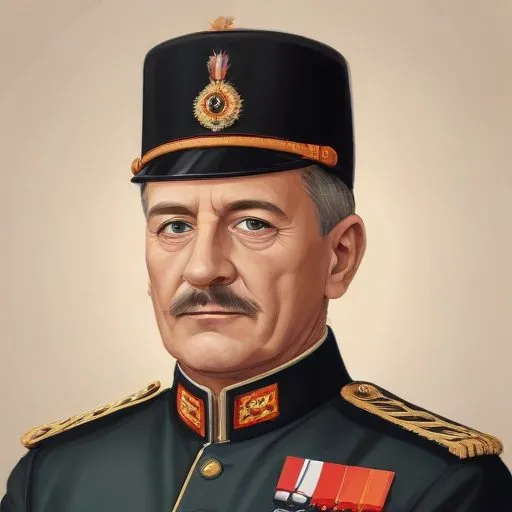
A German Chancellor who served from 1900 to 1909, known for his aggressive foreign policy and role in escalating tensions leading to World War I.
Bernhard von Bülow, a German statesman, served as the Chancellor of the German Empire and Minister-President of Prussia from 1900 to 1909, transforming Germany into a global power through his fervent support of Weltpolitik. His ambition to turn Germany into a world power, however, contributed significantly to the outbreak of World War I.
Born on May 3, 1849, into a prominent family of Danish-German aristocrats, Bülow entered the German foreign service after his father, Bernhard Ernst von Bülow, was appointed foreign secretary in Otto von Bismarck's government. He held several diplomatic posts, including German ambassador to Rome, before being appointed foreign secretary in 1897 by Wilhelm II.
As Chancellor, Bülow promoted cautious and conservative domestic policies while pursuing an ambitious and expansionist policy in foreign affairs. His open challenge to France's growing control over Morocco sparked the First Moroccan Crisis, which aggravated the French and the British and helped strengthen the Entente Cordiale.
In 1908, Wilhelm's indiscreet remarks were published during the Daily Telegraph Affair, causing significant damage to German foreign relations and the Kaiser's prestige. Bülow was blamed for failing to prevent the blunder and, having lost the support of both the Kaiser and the Reichstag, he resigned in 1909 and was succeeded by Theobald von Bethmann Hollweg.
Despite presiding over sustained economic growth and major technological advancements within Germany, Bülow's government's foreign policy did much to antagonize France and Great Britain. His legacy is marked by controversy, with many historians criticizing his aggressive foreign policy for contributing to the outbreak of World War I.
After his resignation, Bülow moved to Rome and came out of retirement in late 1914 to serve as interim ambassador to Italy. He passed away on October 28, 1929, leaving behind a complex legacy that continues to be debated by historians today.
Bülow was a staunch supporter of Weltpolitik, believing that Germany needed to assert its dominance on the global stage. His foreign policy was guided by a strong sense of nationalism and a desire to expand Germany's influence and power.
Bülow's tenure as Chancellor marked a significant turning point in German history, as the country began to assert its dominance on the global stage. His legacy serves as a reminder of the importance of diplomacy and the dangers of aggressive foreign policy.
Bülow's expansionist policies and aggressive foreign policy have had a lasting impact on modern society, shaping the course of international relations and informing the foreign policy decisions of nations around the world.
Bülow's rise to power and influence serves as a testament to the power of hard work, determination, and strategic thinking. His legacy continues to inspire and educate historians and politicians around the world.
Born in 1815
Unified Germany's founder, a master strategist who forged a nation through diplomacy and war, leaving a lasting legacy in European politics.
Born in 1856
A German lawyer and politician who served as the 5th Chancellor of Germany from 1909 to 1917, known for his role in leading Germany into World War I. He implemented policies that led to the war, including the invasion of neutral Belgium, which drew Britain into the conflict.
Born in 1847
A German field marshal and politician who served as the 2nd President of Germany during the Weimar Republic, playing a crucial role in the rise of the Nazi Party. He's infamous for appointing Adolf Hitler as Chancellor of Germany in 1933.
Born in 1865
A German general and politician who played a crucial role in World War I, masterminding the 1918 Spring Offensive and later promoting Nazi ideology.
Born in 1879
A German nobleman who served as Chancellor of Germany in 1932, known for his role in appointing Adolf Hitler as Chancellor, paving the way for the Nazi regime.
Born in 1882
A German general and politician who briefly served as Chancellor of Germany in 1933, known for his failed attempts to stabilize the Weimar Republic and his role in Hitler's rise to power.
Born in 1889
The dictator of Nazi Germany, responsible for the genocide of six million Jews and millions of other people during World War II, and infamous for his extreme nationalist and anti-Semitic ideology.
Born in 1897
A mastermind of Nazi propaganda, he crafted a persuasive narrative that fueled the Third Reich's rise to power, leaving a lasting impact on the world.
