


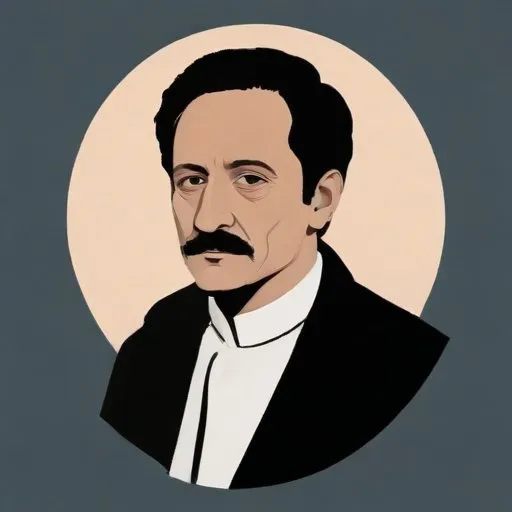
A Renaissance humanist who contributed significantly to the development of the Italian language and literature, known for his poetic and dramatic works that showcased his mastery of classical forms.
Gian Giorgio Trissino, a Venetian Renaissance humanist, is renowned for his groundbreaking proposal to introduce new letters to the Italian alphabet, distinguishing J from I and V from U. This innovative idea not only showcases his linguistic expertise but also highlights his commitment to refining the Italian language.
Trissino was born on July 8, 1478, in Vicenza, Italy, to a noble family. He received a comprehensive humanistic education, studying Greek under the esteemed Demetrios Chalkokondyles in Milan and philosophy under Niccolò Leoniceno in Ferrara. This solid foundation in the humanities laid the groundwork for his future achievements.
Trissino's diplomatic skills and cultural refinement earned him the favor of prominent figures, including Pope Leo X, Pope Clement VII, and Pope Paul III. He served as a nuncio to Germany and later as an ambassador, leveraging his diplomatic prowess to navigate the complex web of Renaissance politics.
In 1532, Emperor Charles V conferred upon Trissino the title of count palatine, solidifying his reputation as a respected statesman and intellectual.
Trissino's literary output is notable, particularly his tragedy Sophonisba, written around 1515 and published in 1524. This work, based on the life of the Carthaginian lady Sophonisba, demonstrates his mastery of dramatic form and his ability to engage with classical themes.
From 1538 to 1540, Trissino returned to his studies at the University of Padua, where he delved into the works of Plato and grappled with the question of free will. This period of intense philosophical inquiry underscores his commitment to intellectual pursuits.
Gian Giorgio Trissino's contributions to the Italian Renaissance are multifaceted and far-reaching. His work in linguistics, diplomacy, literature, and philosophy has left an indelible mark on the cultural landscape of his time.
His influence extends beyond his own era, as he occupies a prominent place in the history of modern European literature. Trissino's legacy serves as a testament to the power of humanism and the Renaissance spirit.
Despite his many achievements, Trissino's family life was marked by turmoil. His initial support for Holy Roman Emperor Maximilian's plans led to his exile from Vicenza, a punishment later commuted through the intervention of Pope Leo X.
Trissino's homes, wherever he resided, became gathering places for scholars, literati, and prominent figures of the time, solidifying his reputation as a patron of the arts and a magnet for intellectual curiosity.
In conclusion, Gian Giorgio Trissino's diverse pursuits and achievements have cemented his position as a towering figure of the Italian Renaissance. His innovative spirit, intellectual curiosity, and commitment to humanism continue to inspire and educate scholars and enthusiasts alike.
Born in 1470
A 16th-century Renaissance humanist who wrote influential poetry and treatises on literature, and was a key figure in developing the modern Italian language.
Born in 1469
Italian historian and philosopher who wrote "The Prince", a seminal work on politics and power that still influences modern leadership and governance today.
Born in 1474
Renowned for epic poems, particularly "Orlando Furioso", which masterfully blended chivalric romance and Renaissance humanism, influencing literature for centuries.
Born in 1478
A Renaissance man who wrote "The Courtier," a influential book on etiquette and courtly behavior, shaping the ideal of the perfect gentleman. His work remains a cornerstone of Western cultural heritage.
Born in 1463
Renaissance humanist and philosopher who wrote the famous "Oration on the Dignity of Man," a treatise that declared human beings' potential for greatness and their capacity for self-improvement. He's known for his emphasis on humanism and individualism.
Born in 1433
An Italian Renaissance philosopher who translated Plato's works into Latin, reviving classical Greek philosophy and influencing the development of Western esotericism. He's also known for his astrological writings and their impact on Renaissance thought.
Born in 1544
A 16th-century poet and educator who wrote influential epic poems, particularly "Jerusalem Delivered", which showcased his mastery of Italian language and style.
