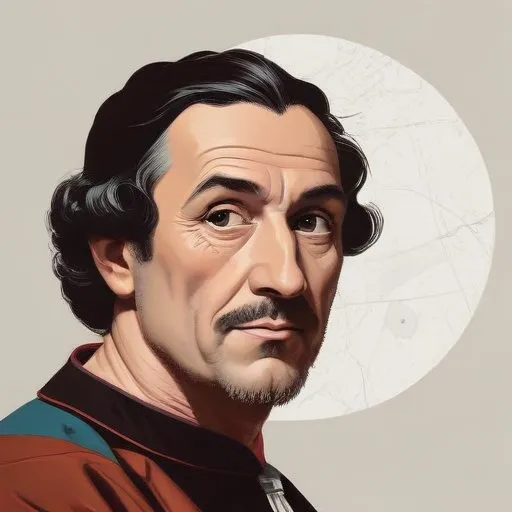
Giovanni Antonio Magini: The Pioneering Astronomer and Cartographer
Early Life and Education
Giovanni Antonio Magini, a renowned Italian astronomer, astrologer, cartographer, and mathematician, was born on June 13, 1555, in Padua. He earned a degree in philosophy from the University of Bologna in 1579, laying the foundation for his future contributions to the fields of astronomy and cartography.
Career Highlights and Major Works
Magini's most notable work is his support for the geocentric system of the world, in opposition to Copernicus's heliocentric system. He developed his own planetary theory, known as the Maginian System, which consisted of eleven rotating spheres. This theory was described in his book
Novi clestium orbium theoric congruentes cum observationibus N. Copernici, published in Venice in 1589.
Other notable works include:
- Ephemerides coelestium motuum, published in 1582, which marked the beginning of his astronomical pursuits.
- De Planis Triangulis, published in 1592, which described the use of quadrants in surveying and astronomy.
- Tabula tetragonica, published in 1592, which comprised extremely accurate trigonometric tables.
- A commentary on Ptolemy's Geographia, published in Venice in 1596.
Cartographic Contributions
Magini's magnum opus was the preparation of
Italia, or the
Atlante geografico d'Italia (Geographic Atlas of Italy), which was printed posthumously by his son in 1620. This monumental work aimed to include maps of every Italian region with exact nomenclature and historical notes.
Personal Milestones and Key Life Events
In 1588, Magini was chosen over
Galileo Galilei to occupy the chair of mathematics at the University of Bologna, following the death of Egnatio Danti. He died on February 11, 1617, in Bologna.
Philosophical Contributions and Beliefs
Magini's work reflects his strong support for the geocentric system of the world, which was a widely accepted view during his time. He dedicated his life to developing his own planetary theory, which although flawed, demonstrated his commitment to understanding the celestial sphere.
Influence on Modern Society
Magini's work in astronomy and cartography has had a lasting impact on the development of these fields. His trigonometric tables, in particular, were highly accurate and remained a valuable resource for astronomers and mathematicians for centuries.
Legacy
Giovanni Antonio Magini's contributions to astronomy and cartography have secured his place in the annals of scientific history. His pioneering work in these fields continues to inspire and influence scholars to this day.
Trivia and Fun Facts
- Magini's father, Pasquale Magini, was a citizen of Padua.
- He worked as a tutor in mathematics to the sons of Vincenzo I of Gonzaga, Duke of Mantua, to fund his cartographic projects.
FAQ
What were Giovanni Antonio Maginis contributions to cartography?
Giovanni Antonio Magini was a Italian cartographer and astronomer who made significant contributions to the field of cartography. He is known for his accurate and detailed maps of Italy and the Mediterranean region.
What was Giovanni Antonio Maginis role in the development of astronomy?
Giovanni Antonio Magini was an astronomer who made important contributions to our understanding of the universe. He observed the heavens using telescopes and made accurate measurements of celestial bodies.
What were Giovanni Antonio Maginis mathematical contributions?
Giovanni Antonio Magini was a mathematician who made important contributions to the field of trigonometry. He wrote several books on mathematics and was known for his ability to apply mathematical concepts to real-world problems.
What was Giovanni Antonio Maginis relationship like with other scientists?
Giovanni Antonio Magini corresponded with other prominent scientists of his time, including Galileo Galilei. He was known for his erudition and his ability to engage in lively debates about scientific topics.
What is Giovanni Antonio Maginis legacy today?
Giovanni Antonio Maginis legacy today is as a pioneering cartographer, astronomer, and mathematician who contributed significantly to our understanding of the world. He is remembered as a dedicated scholar and a talented scientist.