


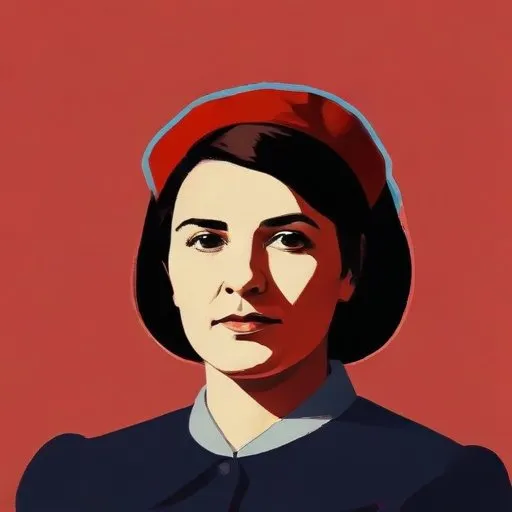
An Italian communist and Partisan who fought against Fascist and Nazi forces during World War II, known for her bravery and leadership in the resistance movement.
Giuseppina Tuissi, affectionately known as Gianna, is renowned for her bravery and crucial role in the execution of Benito Mussolini, the fascist dictator of Italy, during World War II. As a member of the 52nd Brigata Garibaldi Luigi Clerici, she worked closely with partisan Luigi Canali, also known as Captain Neri, to orchestrate the capture and eventual demise of Mussolini and his mistress, Clara Petacci.
Born on June 23, 1923, in Abbiategrasso, Milan, Giuseppina grew up in a humble background, working as a laborer in the suburb of Baggio. Her life took a dramatic turn in 1943 when she joined the partisan movement, adopting the pseudonym Gianna. As a courier, she played a significant role in the Italian resistance, using her wit and cunning to evade detection by the fascist authorities.
On January 6, 1945, Giuseppina was arrested alongside Captain Neri in Lezzeno by the XI Black Brigade, led by Cesare Rodini. She was subjected to 23 days of brutal torture, which failed to break her spirit or extract information about her comrades. Her courage in the face of adversity impressed even her captors, including a Gestapo officer, Captain Vernig, who eventually secured her release on March 12.
Giuseppina continued to fight for the partisan cause, refusing an opportunity to escape to Switzerland. She played a pivotal role in the capture and execution of Mussolini and Petacci on April 27-28, 1945, near Dongo. However, her actions during her detention raised suspicions among her comrades, and she was arrested again on April 29 in Baggio. After being released on May 9, she began to investigate the circumstances surrounding Captain Neri's death, which had occurred under mysterious circumstances.
Giuseppina's relentless pursuit of truth led her to meet Ferruccio Lanfranchi, editor of the Corriere d'Informazione, who was investigating Mussolini's death. Feeling abandoned by her comrades, she disappeared on June 23, 1945, her 22nd birthday. It is presumed that she was killed, and her body was thrown into Lake Como, a tragic end to a life marked by bravery and sacrifice.
Giuseppina Tuissi's remarkable story serves as a testament to the courage and resilience of women who fought against fascist oppression during World War II. Her contribution to the Italian resistance movement and her role in bringing an end to Mussolini's reign of terror have cemented her place in history as a hero and a symbol of resistance.
Born in 1893
An Italian politician who played a crucial role in shaping the country's post-WWII government and was a key figure in the Italian Communist Party, known for his efforts to reform the justice system.
Born in 1891
An Italian philosopher and politician who developed the concept of cultural hegemony, arguing that power is maintained through cultural and ideological means, rather than just economic or political control.
Born in 1922
Leader of the Italian Communist Party who implemented a policy of Eurocommunism, seeking to reform the party and distance it from Soviet influence.
Born in 1887
An Italian war hero and statesman who served as President of the Italian Republic from 1955 to 1962, known for his efforts to rebuild and stabilize post-war Italy.
Born in 1896
A courageous anti-fascist journalist and politician who served as President of Italy, known for his strong democratic values and commitment to social justice.
