


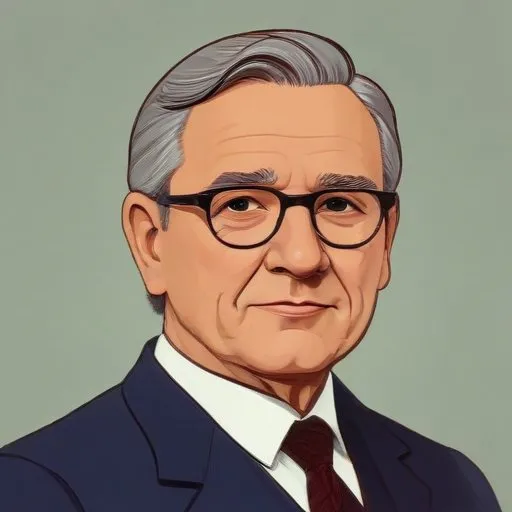
An American historian and author who specialized in the Pacific Theater of World War II, particularly the Pearl Harbor attack, and wrote extensively on the subject.
Gordon Prange was a renowned historian and author, best known for his meticulous research and insightful writings on World War II, particularly the events leading up to and during the attack on Pearl Harbor. His work, much of which was published posthumously, has become a cornerstone of historical understanding, inspiring films, documentaries, and further research.
Gordon William Prange was born on July 16, 1910, in Pomeroy, Iowa, to Al and Johanna Prange. He grew up with a passion for history, which led him to pursue a career in academia. Prange earned his degree in history from the University of Iowa and later obtained his Ph.D. from the University of Wisconsin.
Prange's academic pursuits were interrupted by World War II, during which he served in the United States Navy from 1942 to 1951. This period proved pivotal in shaping his research focus, as he was assigned to the staff of General Douglas MacArthur during the post-war occupation of Japan. As Chief Historian, Prange had unparalleled access to Japanese military officers, enlisted men, and civilians, collecting valuable primary sources that would later form the basis of his writings.
Prange's research and writing led to the publication of several acclaimed books, including At Dawn We Slept: The Untold Story of Pearl Harbor and Miracle at Midway, both of which became New York Times bestsellers. His 1963 article Tora! Tora! Tora!, published in Reader's Digest, was later adapted into a film of the same name, with Prange serving as technical consultant.
Prange's work has been widely praised for its accuracy, detail, and insight. The Washington Post hailed At Dawn We Slept as the "definitive book on the event." A 2000 PBS documentary, Prange and Pearl Harbor: A Magnificent Obsession, showcased his extensive research and contributions to the field.
Prange was a beloved professor of history at the University of Maryland, where he taught from 1937 to 1980. His engaging lectures, which often featured dramatic reenactments of historical events, were extremely popular among students. The university's yearbook, The Terrapin, described his classes as "electrifying," with students "flocking" to attend.
Gordon Prange passed away on May 15, 1980, leaving behind a rich legacy of historical research and writings. His work continues to inspire historians, authors, and filmmakers, ensuring that the events of World War II remain vivid and accessible to future generations.
Through his tireless research, engaging writings, and dedication to education, Gordon Prange has left an indelible mark on our understanding of World War II, ensuring that the stories of those who lived through it are preserved for generations to come.
Born in 1884
Led the Imperial Japanese Navy during World War II, masterminding the surprise attack on Pearl Harbor, and later became a symbol of Japanese military power and strategy.
Born in 1885
Led the U.S. Pacific Fleet to victory in World War II, playing a crucial role in defeating Japan and ending the war. He was a highly respected and decorated naval leader.
Born in 1880
A highly decorated war hero and master strategist who led troops to victory in World War I and II, and later became a prominent figure in the occupation of Japan.
Born in 1901
The Japanese emperor who ruled from 1926 to 1989, leading the country through World War II and its post-war reconstruction, and is known for his symbolic role in Japanese politics and culture. He is also remembered for his rare public apology for Japan's wartime atrocities.
Born in 1883
Led the Chinese Expeditionary Force in Burma during World War II, earning the nickname "Vinegar Joe" for his acerbic personality and fighting spirit. He played a crucial role in reopening the Burma Road, a vital supply route to China.
Born in 1886
A highly decorated naval officer who played a crucial role in several key battles in World War II, including the Battle of Midway, and later served as a diplomat.
Born in 1906
A pioneering Air Force general who played a crucial role in shaping the US military's strategic bombing capabilities during World War II and the Cold War. He's also known for his hawkish stance on communism and his influence on US foreign policy.
