


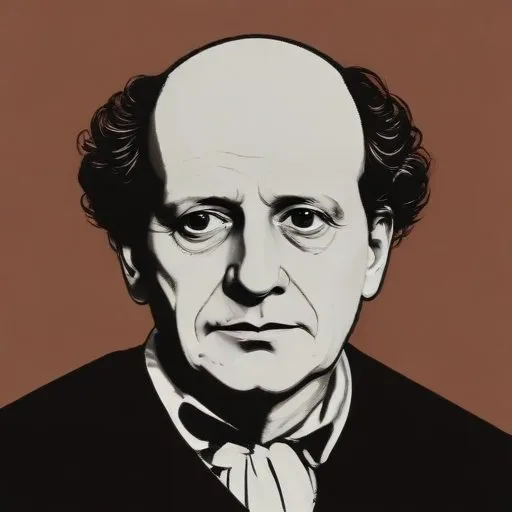
A 19th-century mathematician who made significant contributions to number theory, particularly in the development of elliptic functions and modular forms.
Gotthold Eisenstein was a German mathematician known for his groundbreaking contributions to number theory and analysis, proving several results that eluded even the great Carl Friedrich Gauss. Despite his tragically short life, Eisenstein left an indelible mark on the mathematical community, cementing his place among the greatest minds of his time.
Born on April 16, 1823, in Berlin, Prussia, to a family of Jewish descent who had converted to Protestantism, Eisenstein demonstrated an extraordinary talent for mathematics and music from a young age. He suffered various health problems throughout his life, including meningitis as an infant, which took the lives of all five of his brothers and sisters.
Despite these challenges, Eisenstein's teachers recognized his exceptional abilities in mathematics, and by the age of 15, he had already learned all the material taught at the Friedrich Wilhelm Gymnasium. He then began to study differential calculus from the works of Leonhard Euler and Joseph-Louis Lagrange.
At just 17 years old, still a student, Eisenstein began attending classes given by Peter Gustav Lejeune Dirichlet and others at the University of Berlin. This exposure sparked a period of incredible productivity, during which he presented his first work to the Berlin Academy in 1843, on cubic forms in two variables.
Over the next five years, Eisenstein produced some of his most remarkable works, including his papers on elliptic functions, the theory of quadratic forms, and the proof of the impossibility of solving fifth-degree polynomials using radicals. His findings earned him recognition from prominent mathematicians, including William Rowan Hamilton, who gifted him a copy of his book on Niels Henrik Abel's proof.
Eisenstein's untimely death at the age of 29, on October 11, 1852, was a devastating blow to the mathematical community. However, his work continued to inspire and influence generations of mathematicians, including the likes of Richard Dedekind, Leopold Kronecker, and David Hilbert.
Today, Eisenstein's contributions to number theory and analysis remain a testament to his extraordinary talent and dedication. His work continues to shape the field, with his name becoming synonymous with excellence in mathematical research.
Despite his intense focus on mathematics, Eisenstein was also an accomplished pianist and composer. He continued to play and compose music throughout his life, finding solace in the creative outlet.
Eisenstein's meeting with William Rowan Hamilton in Dublin in 1843 was a pivotal moment in his life, as it introduced him to Abel's proof and sparked his interest in mathematical research.
Born in 1777
A pioneer in mathematics and physics, he made major contributions to number theory, algebra, and electromagnetism, shaping our understanding of the natural world.
Born in 1826
A pioneering mathematician who developed the theory of higher dimensions and laid the foundations for modern physics, particularly in the understanding of space and time.
Born in 1805
A German mathematician and academic who made significant contributions to number theory, particularly in the development of the Dirichlet's theorem, and was one of the first mathematicians to give lectures on the subject. He also worked on the theory of Fourier series and its applications.
Born in 1810
Developed a theory of ideal numbers, which laid the foundation for modern algebraic number theory, and made significant contributions to the field of mathematics.
Born in 1849
A pioneer in geometry and group theory, known for developing the Erlangen program, which unified various geometries under a single framework. His work laid foundations for modern algebraic geometry and topology.
Born in 1831
Developed a rigorous definition of real numbers and introduced the concept of Dedekind cuts, revolutionizing mathematics and laying the foundation for modern analysis. His work also explored the nature of infinity and the foundations of mathematics.
Born in 1862
A renowned mathematician and academic who developed infinite-dimensional vector spaces and laid the foundation for quantum mechanics and relativity. He's also famous for his 23 unsolved math problems that shaped 20th-century mathematics.
