


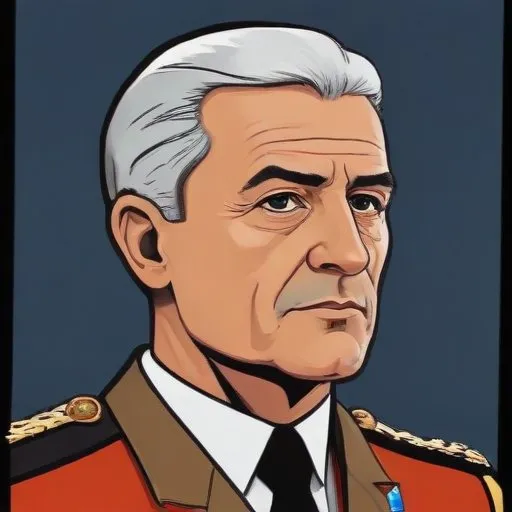
A French military leader and diplomat who played a key role in Napoleon's government, serving as Grand Marshal of the Palace and Ambassador to Russia. He's known for his bravery and strategic thinking during the Napoleonic Wars.
Graud Duroc, Duke of Frioul, was a French general and diplomat who left an indelible mark on the annals of history. He is renowned for his unwavering loyalty and intimate friendship with Napoleon Bonaparte, which earned him the esteemed position of Grand Marshal of the Palace, head of the Emperor's military household.
Duroc was born on 25 October 1772, in Pont-à-Mousson, to a noble family of Gévaudan. His father, Claude du Roc, a former captain of the dragoons, had retired to Pont-à-Mousson due to hearing loss. Duroc's early life was marked by a strong inclination towards the military. He entered the local military school in 1781, where he studied for eight years. This was followed by his admission to the School of Artillery of Châlons as a second lieutenant in March 1792.
As a member of the nobility, Duroc initially opposed the French Revolution and joined the counter-revolutionary Army of Condé. However, after the Battle of Valmy, he deserted the royalist army and was arrested by the French in Fresnes-en-Woëvre. He was later allowed to return to Châlons and finish his education. Duroc joined the French Revolutionary Army on 1 June 1793, rapidly advancing in the service. His devotion to Napoleon was rewarded with complete confidence, and he became aide-de-camp to Napoleon in 1796.
Duroc distinguished himself in various military campaigns, including the Italian campaigns of 1796-1797, where he fought at Isonzo, Brenta, and Gradisca. He served in Egypt and was severely wounded at the Battle of Abukir. Despite his injuries, Duroc's loyalty and dedication to Napoleon remained unwavering, earning him the esteemed position of Grand Marshal of the Palace.
Duroc's close proximity to Napoleon and his involvement in the highest echelons of power allowed him to influence the Emperor's decisions and policies. Although his personal beliefs and philosophical contributions are not extensively documented, it is evident that Duroc was a staunch supporter of Napoleon's vision for France and Europe.
Duroc's legacy lies in his unwavering loyalty and dedication to Napoleon, which earned him a place in history as one of the Emperor's most trusted advisors. His influence on modern society is reflected in the Napoleonic Code, which continues to shape the legal systems of many countries to this day.
Although there are no recorded quotes or memorable sayings attributed to Duroc, his actions and dedication to Napoleon speak volumes about his character and loyalty.
Duroc's life and legacy are inextricably linked with Napoleon's rise and fall. He played a crucial role in shaping the Emperor's military and diplomatic strategies, and his loyalty remained unwavering until his death in 1813. Duroc's legacy serves as a testament to the power of loyalty and dedication in the face of adversity.
Born in 1769
A French military leader who rose to prominence during the French Revolution and became Emperor of France, known for his military conquests and reorganization of Europe. He is also famous for his Napoleonic Code, which remains a foundation of modern law.
Born in 1767
A flamboyant and daring cavalry commander who played a key role in Napoleon's military conquests, earning the title of King of Naples.
Born in 1770
A renowned military strategist and statesman who played a crucial role in Napoleon's conquests and later became a key figure in French politics, known for his exceptional organizational skills and bravery.
Born in 1758
A skilled military strategist and one of Napoleon's most trusted generals, known for his victories in the Peninsular War and his role in shaping modern warfare.
Born in 1769
A skilled military strategist and one of Napoleon's most trusted generals, known for his bravery and tactical genius on the battlefield.
Born in 1769
A skilled and fearless military leader, known for his bravery and tactical genius on the battlefield, particularly during the Napoleonic Wars.
Born in 1759
A French lawyer and politician who served as Minister of Police under Napoleon, notorious for his ruthless suppression of dissent and creation of a vast network of spies and informants.
