


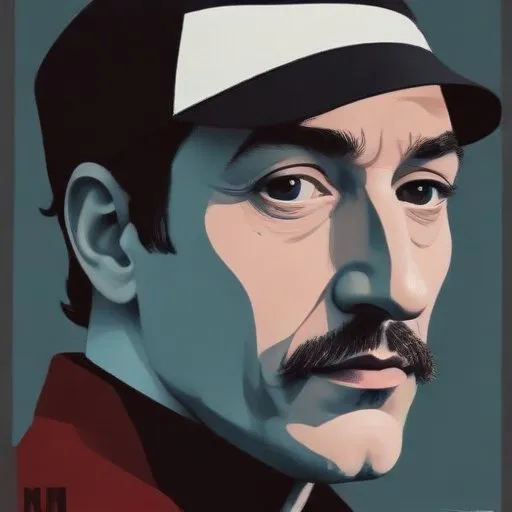
A French painter and sculptor celebrated for his dreamlike, Symbolist-inspired works that often blended fantasy and reality. His art typically features mystical, androgynous figures and eerie landscapes.
Guy de Lussigny, a renowned French painter, is best known for his contributions to the school of geometric abstraction. His work, characterized by precise lines, squares, and vibrant colors, has earned him a prominent place in the art world.
Born on August 30, 1929, in Cambrai, northern France, Lussigny's artistic journey began in 1950. Initially, he explored figurative painting, but soon followed in the footsteps of Piet Mondrian and Kazimir Malevich, embracing geometric abstraction.
A chance meeting with Gino Severini, a founder of the Italian Futurist movement, in 1955, proved to be a turning point in Lussigny's career. Severini's encouragement to pursue geometric abstraction led to a significant shift in Lussigny's artistic style. Another influential encounter was with Auguste Herbin in 1956, which further solidified Lussigny's commitment to color theory and geometric abstraction.
Lussigny's talent was soon recognized, and he was awarded the prestigious Prix Dumas-Millier by the Institut de France and the Académie des Beaux-Arts in 1968. This accolade cemented his position as a leading figure in geometric abstraction.
Lussigny's artistic career spanned over five decades, during which he exhibited his work regularly in France, Europe, and Japan. His paintings can be found in numerous public collections, including the French National Museum of Modern Art.
Lussigny's work has inspired generations of artists, and his contributions to geometric abstraction continue to influence contemporary art. His legacy extends beyond the art world, as his paintings evoke a sense of order, harmony, and balance, offering a poetic respite from the chaos of modern life.
Lussigny's friendships with artists, including Antonio Calderara, Hans Steinbrenner, and Francesco Marino Di Teana, played a significant role in his life. These relationships not only provided creative stimulation but also fostered a sense of community and camaraderie.
Guy de Lussigny's artistic legacy continues to inspire and educate art lovers around the world. His dedication to geometric abstraction has left an indelible mark on modern art, ensuring his place as one of the most important French painters of the 20th century.
Born in 1841
A pioneer of Impressionism, creating vibrant, intimate portraits and landscapes that capture the beauty of everyday life. His works evoke a sense of joy and warmth, celebrating the human experience.
Born in 1840
A founder of Impressionism, capturing fleeting light and color in dreamy landscapes and water scenes, revolutionizing modern art.
Born in 1830
A Danish-French Impressionist painter who captured the beauty of landscapes and cityscapes with vivid colors and bold brushstrokes, influencing the development of modern art.
Born in 1839
A post-Impressionist pioneer, he's famous for his still-life compositions and landscapes that laid the groundwork for Cubism, influencing 20th-century art.
Born in 1869
A pioneering artist who revolutionized modern art with bold, expressive, and colorful works that blurred the lines between painting and sculpture, creating a new language of form and color.
Born in 1880
A pioneer of Fauvism, a style characterized by vivid colors and energetic brushstrokes, creating a new language of art that paved the way for modernist movements.
Born in 1876
A Fauvist pioneer, known for vibrant, expressive landscapes and still-life paintings that emphasized bold colors and energetic brushstrokes.
Born in 1877
A Fauvist painter who captured the vibrant spirit of Parisian nightlife and high society with bold, expressive brushstrokes and vivid colors.
