


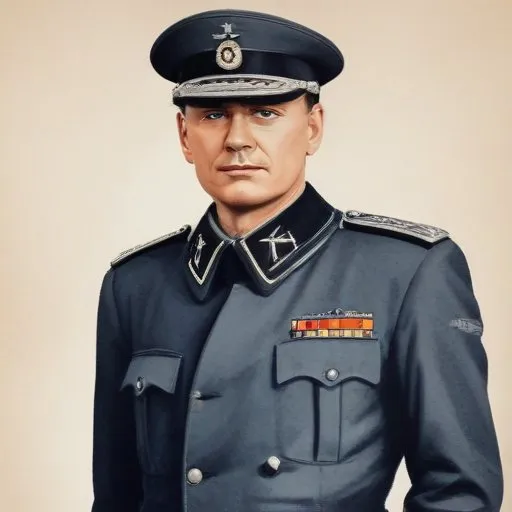
A high-ranking SS officer involved in the Nazi regime's atrocities, particularly in the concentration camps, and later tried for war crimes.
Hans Httig, a German SS functionary, is notoriously known for his role as a Nazi concentration camp commandant during World War II. His reign of terror in the camps earned him a reputation as a ruthless and brutal leader, responsible for countless atrocities and human rights violations.
Httig was born on April 5, 1894, in Germany, to a carpenter father who later opened a photographic equipment shop. His brother went on to become a founder of the renowned Zeiss Ikon company. Httig's early life was marked by failed attempts to join the army and a stint at a boarding school in South Germany. He eventually worked as a salesman in his father's shop before leaving to take a post with an import-export company in German East Africa in 1914.
With the outbreak of World War I, Httig enlisted in the German Imperial Army, seeing action in the East African Campaign. He rose to the rank of Feldwebel before being wounded in December 1917. Httig was captured by the British Army and sent to a POW camp in Cairo, where he was held for two years.
After his return to Germany in 1920, Httig worked in various clerical jobs before joining the right-wing Der Stahlhelm in 1925. He claimed this was to feel a sense of belonging rather than due to deep political convictions. Httig eventually joined the Nazi Party and the SS in 1932, becoming an unpaid volunteer. Following the Nazi seizure of power in 1933, Httig was offered a full-time billet with the SS, rotating through concentration camps and training for a career in the SSTotenkopfverbände Camp SS.
Httig's assignments in the concentration camps cemented his reputation as a ruthless and brutal leader. He spent six years rotating through the camps, honing his skills and rising through the ranks. His experience as a commandant was marked by brutality, torture, and human rights violations, earning him the fear and resentment of those under his command.
Hans Httig's role in the Nazi concentration camps serves as a grim reminder of the atrocities committed during World War II. His story serves as a testament to the dangers of blind obedience, ideological extremism, and the corrupting influence of power. As we reflect on the horrors of the past, it is essential to remember the lives lost, the families destroyed, and the lessons learned from the dark chapters of human history.
Httig's legacy extends beyond the confines of the concentration camps, serving as a cautionary tale about the dangers of unchecked power, xenophobia, and extremism. His story has contributed to a broader understanding of the importance of human rights, tolerance, and empathy. As we navigate the complexities of modern society, it is crucial to remember the lessons of the past, ensuring that such atrocities are never repeated.
Hans Httig's life serves as a stark reminder of the devastating consequences of blind loyalty, ideological extremism, and the corrupting influence of power. As we reflect on his story, we are compelled to remember the importance of empathy, tolerance, and human rights, ensuring that the atrocities of the past are never repeated.
Born in 1900
Leading the SS and Gestapo, he oversaw the Nazi regime's brutal security apparatus and implemented the "Final Solution," orchestrating the genocide of six million Jews during World War II.
Born in 1889
The dictator of Nazi Germany, responsible for the genocide of six million Jews and millions of other people during World War II, and infamous for his extreme nationalist and anti-Semitic ideology.
Born in 1904
A high-ranking Nazi official and chief architect of the Holocaust, responsible for implementing the "Final Solution" that led to the murder of six million Jews and millions of others during World War II.
Born in 1903
Austrian-German lawyer and general who served as the highest-ranking leader of the Nazi police forces, responsible for overseeing the Gestapo, SS, and concentration camps during World War II. He was a key figure in the Holocaust and other atrocities committed by the Nazi regime.
Born in 1896
A high-ranking Waffen-SS officer who played a crucial role in several key battles on the Eastern Front during World War II, known for his military prowess and tactical genius.
Born in 1892
A ruthless and efficient administrator who oversaw the creation and operation of Nazi concentration camps during World War II, responsible for the deaths of millions of people.
Born in 1889
High-ranking SS officer responsible for overseeing the administration of concentration camps during World War II, implementing brutal policies and overseeing mass atrocities.
